
Plumpton Park Zoo · Rising Sun, Maryland
Snowy Owl
Bubo scandiacus
Golden eyes and dense white feathers, built for the Arctic. Discover our snowy owl at Plumpton Park Zoo in Rising Sun, Maryland.
WingspanUp to 5.5 ft
Weight3.5–6.5 lb
Wild lifespanAbout 10 years
At Plumpton ParkSnowy owl
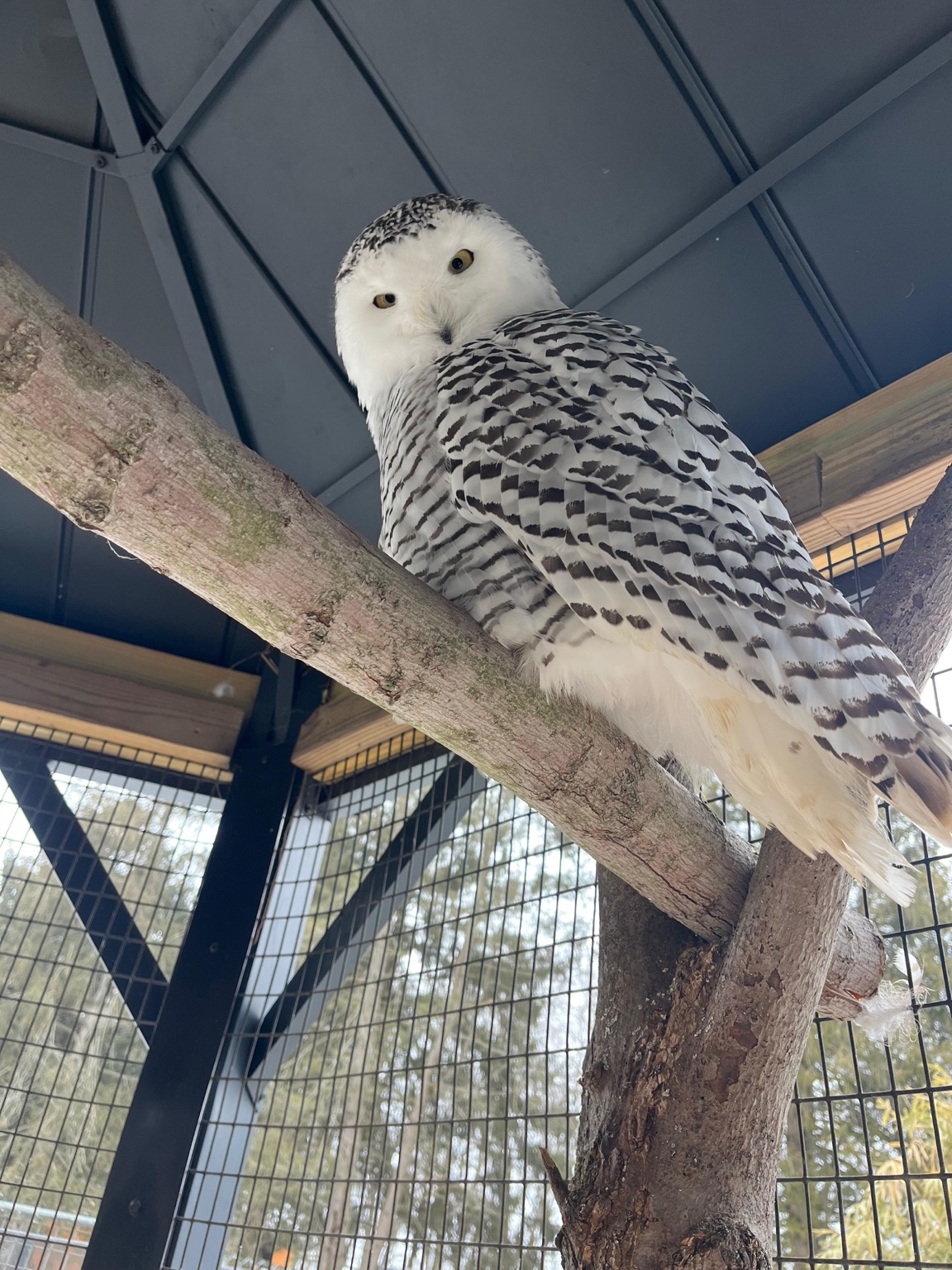
Hedwig perched beneath the roof of her habitat. Photo supplied by Plumpton Park Zoo.
Meet Hedwig
Keeping Hedwig comfortable
Hedwig, our snowy owl, has a fan built into the roof of her habitat to help keep her cool.
Her habitat reflects the needs of a bird adapted to the Arctic. The dense feathers that insulate snowy owls against northern cold make temperature an important consideration when caring for them in Maryland. Hedwig’s roof fan is one way her surroundings have been adapted for her comfort.
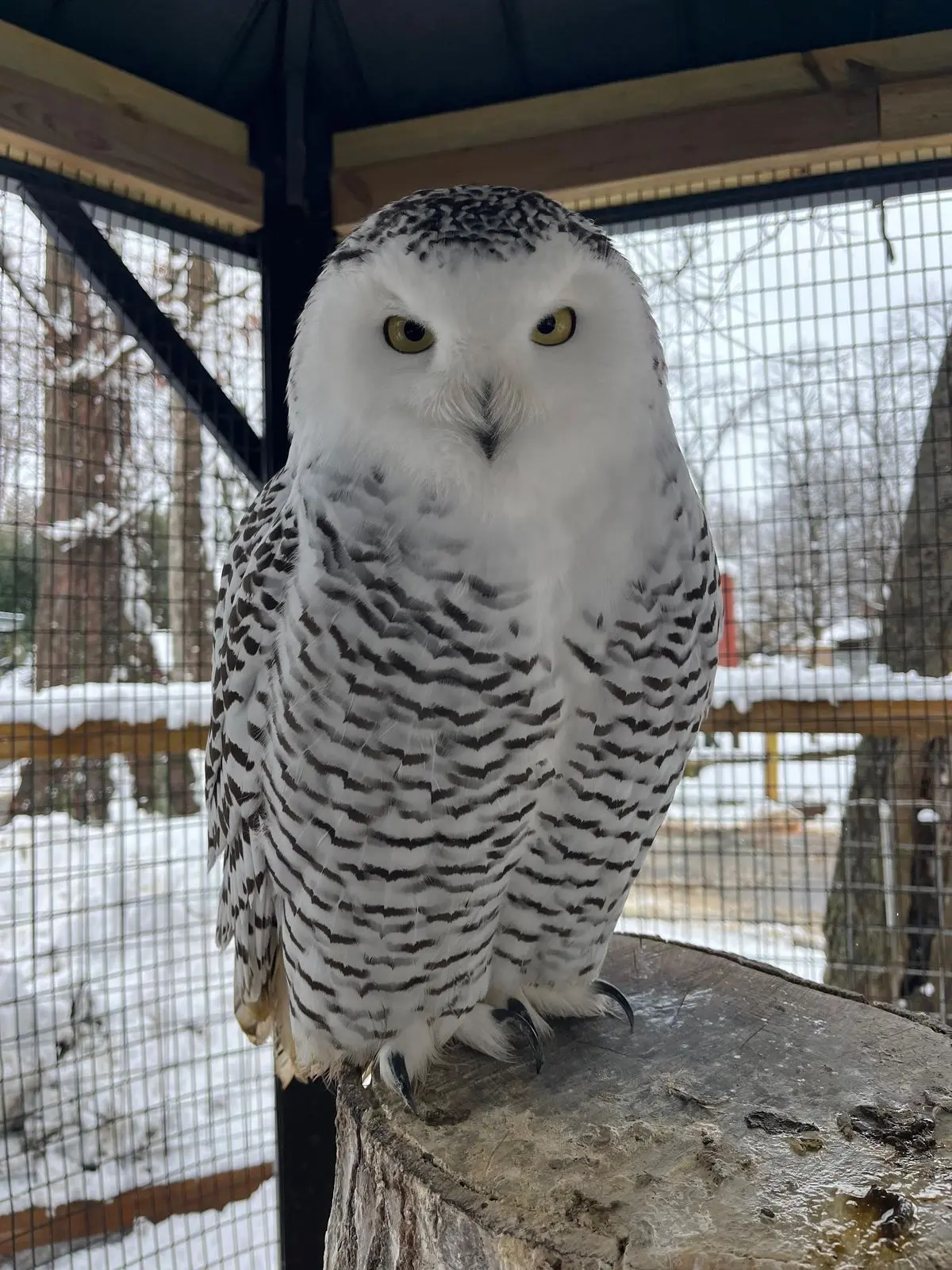
Hedwig’s yellow eyes and patterned plumage make her easy to pick out in these photographs. Her dark markings provide a useful contrast to the almost entirely white adult males often pictured in books and films.
During your visit, take time to watch her from the visitor area. Meeting Hedwig offers a close look at an Arctic bird while showing how a habitat can be adapted to the needs of the animal living in it.
Sources: Plumpton Park Zoo (Hedwig’s name and roof fan); Cornell Lab of Ornithology.
For teachers and homeschool families
A free one-page snowy owl fact sheet with fast facts, words to know, discussion questions and a drawing activity. Teachers may copy and share it freely as long as they credit Plumpton Park Zoo.
Field guide
Snowy owls at Plumpton Park Zoo
Native to the Arctic tundra of North America, Europe, and Asia, the snowy owl is one of the few owl species that hunts by day as readily as by night — a useful adaptation for the nearly round-the-clock daylight of an Arctic summer. Males grow almost pure white as they age, while females keep dark brown flecking across their feathers for life, making the sexes easy to tell apart at a glance.
Snowy owls are built for extreme cold: their legs and feet are covered in some of the densest feathering of any owl, and their plumage sheds heat more slowly than nearly any other bird’s. In the wild, they rely heavily on lemmings, and how many chicks they raise in a given year often tracks how plentiful the local lemming population is.
Come see our snowy owl at Plumpton Park Zoo — plan your visit.

Hedwig, our snowy owl. Photo supplied by Plumpton Park Zoo.
At a glance
Snowy owl fast facts
Scientific nameBubo scandiacus
Size20 – 28 inches, wingspan about 4 to 4¾ feet
Weight3.5 – 6.5 lbs
Lifespanabout 10 years in the wild, 20+ in captivity
RangeArctic North America, Europe and Asia
DietSmall mammals and birds
ConservationVULNERABLE
Measurements from the Cornell Lab of Ornithology; lifespan from our original zoo guide.
Sources: Cornell Lab of Ornithology: identification and measurements; IUCN Red List (BirdLife International).
4¾ ft
Top of the wingspan range, about 57 inches.
Built for open country
Snowy owls favor treeless places and open spaces. A perch or slight rise provides a view over the surrounding hunting ground.
Watchful hunters
Snowy owls may sit in one place for hours, scanning their surroundings. Unlike many other owls, they hunt through the continuous daylight of the Arctic summer.
A quiet owl is still an attentive hunter. Snowy owls watch and listen from a vantage point, then close the distance to prey by flying or sometimes running. Their hunting grounds are often open, giving them a broad view rather than the cover of a forest canopy.
Sources: Cornell Lab of Ornithology, All About Birds.
What snowy owls eat
Snowy owls primarily hunt small mammals such as lemmings and voles, along with birds when available.
Their menu changes with place and opportunity. In the Arctic, lemmings can dominate the diet; elsewhere, snowy owls may take waterfowl, ptarmigan and other birds. This flexibility helps them use different hunting grounds as they move across a large range.
A nest on the tundra
The female makes a shallow scrape on the ground. Food availability influences breeding, linking the lives of these owls closely to their prey.
She shapes the hollow with her body, often on a slightly raised site that stays relatively dry. Young hatch covered in down and depend on their parents for food. A productive lemming year can support more chicks, showing how closely an owl family’s success is tied to conditions on the tundra.
Discover more owls
Compare the snowy owl’s white plumage and open-country habitat with our Barred Owl.
Snowy owl conservation
VULNERABLE
Snowy owls are classified as Vulnerable on the IUCN Red List. The 2021 assessment identifies rapid population declines, making protection of this Arctic species a conservation priority.
Climate change can disrupt the conditions that support their rodent prey. When food becomes less dependable, breeding success can suffer. Protecting Arctic ecosystems and monitoring owl populations help researchers understand these changes.
Sources: IUCN Red List, 2021 assessment; BirdLife International, December 2025.
Studying snowy owls is challenging: breeding areas are remote, territories are large, and winter movements can be unpredictable. Researchers must follow a bird whose life crosses vast distances, rather than one that stays within a small, easily surveyed area. That makes long-term observations valuable for understanding changes in the population.
Sources: Cornell Lab of Ornithology.
Support
Help care for our snowy owl & the animals of Plumpton Park
As a nonprofit zoo, Plumpton Park Zoo relies on admissions, memberships and the generosity of people who believe in what we do. Donations help support animal care, veterinary services, nutritious diets, enrichment, habitat improvements and the continued development of the zoo.
Plumpton Park Zoological Gardens, Inc. is a 501(c)(3) nonprofit organization. Donations support the zoo’s charitable mission and are tax-deductible to the extent permitted by law.
Frequently asked questions about snowy owls
Where do snowy owls live?
They are native to the Arctic tundra of North America, Europe and Asia.
Do snowy owls hunt during the day?
Yes. They hunt by day as well as by night.
What do snowy owls eat?
They hunt small mammals such as lemmings and voles, along with birds.
Where do snowy owls nest?
The female makes a shallow scrape on the tundra.
Are snowy owls all white?
Males often become whiter with age; females retain more dark markings.
Where can I see a snowy owl in Maryland?
Visit Plumpton Park Zoo in Rising Sun, Maryland. Check Hours and Tickets.
See our snowy owl at Plumpton Park Zoo
Explore our birds, Animal Learning Center and giraffe feeding.