Forest cat · Asia

Clouded
Leopard

Neofelis nebulosa

Meet Buster and Tator Tot, Plumpton Park Zoo’s clouded leopards, in Rising Sun, Maryland. Discover the tree-climbing cat with the longest canine teeth, for its size, of any living cat.

A clouded leopard stretched out on a wooden platform in its exhibit at Plumpton Park Zoo in Rising Sun, Maryland
Size27–43 in long
Weight35–51 lb
LifespanAbout 11 years
Conservation statusVulnerable

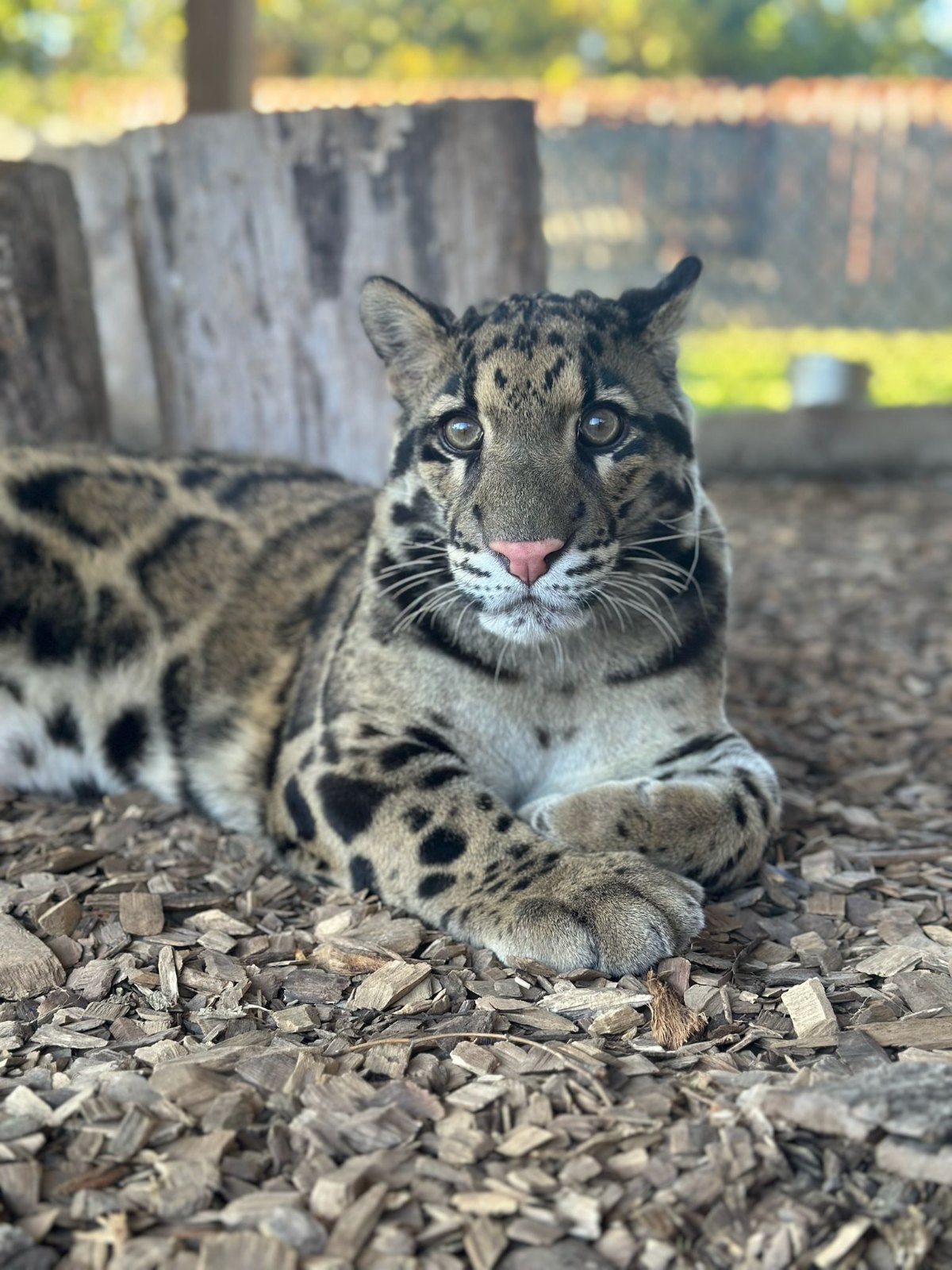
A clouded leopard resting on wood chips and looking at the camera at Plumpton Park Zoo

One of our clouded leopards keeping an eye on visitors.

Our clouded leopards

Buster & Tator Tot

Quiet, still and easy to miss. Take your time at this one.

BusterTator Tot

Buster and Tator Tot are Plumpton Park Zoo’s clouded leopards.

They are among the most striking animals at the zoo, and among the easiest to miss if you hurry past. Clouded leopards are quiet, and they like to lie still on a high perch, so look up as well as in. Clouded leopards are rarely seen in zoos, and like every animal at Plumpton Park, ours are cared for daily by our animal-care team.

For teachers and homeschool families

A free one-page clouded leopard fact sheet with fast facts, words to know, discussion questions and a drawing activity. Teachers may copy and share it freely as long as they credit Plumpton Park Zoo.

Printable Fact Sheet (PDF)

Field guide

Where clouded leopards live

The clouded leopard is a mid-sized wild cat from the dense forests of Southeast Asia, ranging from the foothills of the Himalayas through northeast India and Bhutan into southern China. It ranges from Nepal, Bangladesh and northeast India through Myanmar, Thailand and Indochina, and northeast into southern China; it once lived on Taiwan as well. In India it is found mainly in the Northeast: Arunachal Pradesh, Assam, Meghalaya, Mizoram, Nagaland, Tripura and parts of northern West Bengal.

It prefers lowland tropical rainforest but also uses dry woodlands and secondary forest, and it has been seen in the Himalayan foothills as high as 9,000 feet. Its name comes from the large, cloud-shaped blotches across its coat. Clouded leopards and common leopards belong to different genera within the big-cat lineage: Neofelis and Panthera, respectively.

In 2006, genetic work showed that the clouded leopards of Borneo and Sumatra are a separate species, the Sunda clouded leopard. The mainland species lives at Plumpton Park.

Clouded leopards are so secretive that researchers rely on camera traps and GPS collars, and some spend years in their habitat without ever seeing one. A camera trap is a camera that automatically photographs an animal passing its sensor. GPS collars help researchers track the movements of individual animals. A camera-trap study in Dampa Tiger Reserve, in the Indian state of Mizoram, recorded 84 photos of clouded leopards over 4,962 trap nights, one of the highest densities recorded for the species.

Sources: IUCN SSC Cat Specialist Group; Animal Diversity Web (University of Michigan); National Centre for Biological Sciences (India): Dampa Tiger Reserve study; Deccan Herald (India): Acrobats of the forest (2026).

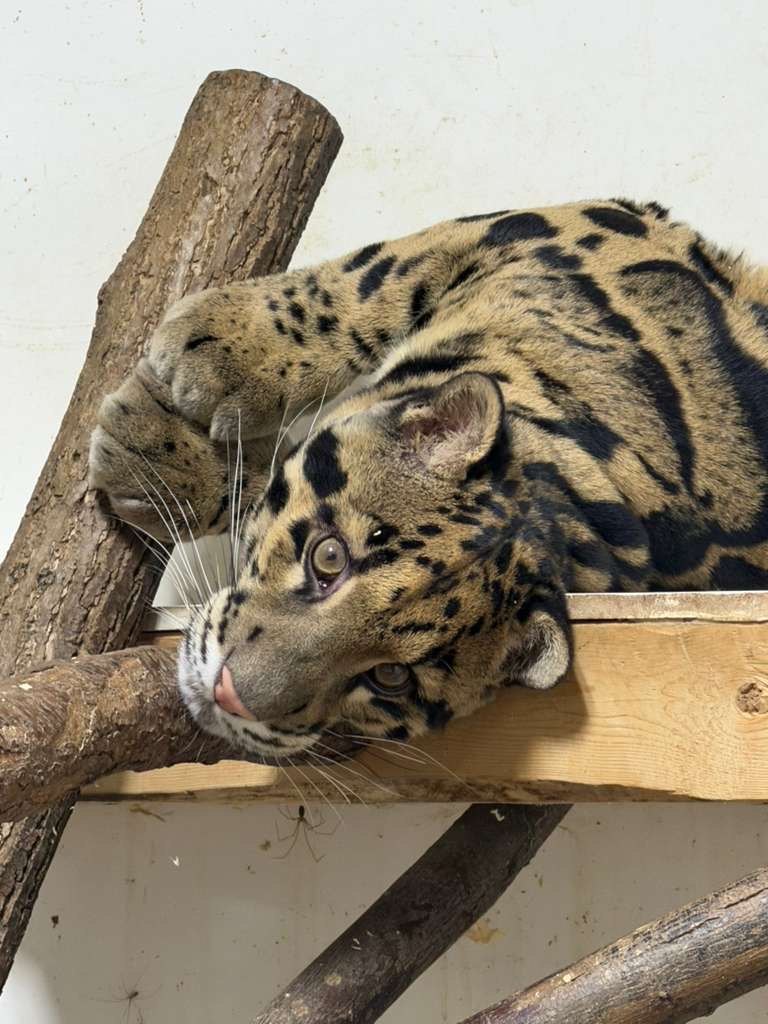
Close view of a clouded leopard's cloud-shaped markings as it rests on a branch at Plumpton Park Zoo

The cloud-shaped blotches that give the clouded leopard its name. At Plumpton Park Zoo.

At a glance

Clouded leopard fast facts

Scientific nameNeofelis nebulosa
FamilyFelidae (cats)
Head and body27–43 in, plus a 24–36 in tail
WeightAbout 35–51 lb; males are larger than females
Litter1–5 cubs, usually 2
At Plumpton ParkBuster & Tator Tot

Lifespan: around 11 years, up to 17 in human care

Our earlier guide recorded “Size: 27 – 42 inches head and body, plus a 24 – 36 inch tail” and “Weight: 25 – 51 lbs”. The current fast facts follow the IUCN Cat Specialist Group’s measurements: 69–108 cm head and body, a 61–91 cm tail and 16–23 kg.

Sources: IUCN SSC Cat Specialist Group; Animal Diversity Web (University of Michigan).

100°

How wide a clouded leopard can open its jaws

A modern-day saber-tooth

The longest teeth for its size

Pound for pound it has the longest canine teeth of any living cat — roughly an inch and a half in an animal that weighs no more than a large dog — which has earned it the nickname of a modern-day saber-tooth.

That earlier description gives an approximate tooth length. Animal Diversity Web puts the canines at about 1.6 inches (4 cm) or longer, the longest of any living cat relative to head and body size. A canine is a long, pointed tooth used to grip prey.

Its jaws open to about 100 degrees, which helps it take large prey. Clouded leopards cannot roar; their calls include growls, hisses and chuffs, a soft snorting greeting. Sources disagree about purring: the IUCN Cat Specialist Group says they purr, while Animal Diversity Web says they do not.

Sources: Animal Diversity Web (University of Michigan); IUCN SSC Cat Specialist Group; Deccan Herald (India): Acrobats of the forest (2026).
Built to climb

Headfirst down a tree

It is also one of the most capable climbers in the cat family: a clouded leopard can walk down a vertical tree trunk head-first, and hang from a branch by its hind paws alone. Very few other cats can climb down a trunk headfirst. Special ankle bones let its hind feet rotate much farther than those of many other wild cats.

Large paws with specialized footpads grip the branches. Its legs are short for its size, with powerful shoulders and muscular limbs, and its long tail helps it balance on branches no wider than a human arm. It can leap about 15 feet from branch to branch.

  • Ankles: hind feet that rotate far back
  • Paws: broad, with gripping footpads
  • Tail: a balancing pole up to 35 in long
  • Teeth: canines about 1.6 in (4 cm) or longer
  • Coat: cloud-shaped blotches that give the cat its name

A clouded leopard climbing headfirst down a branch at Plumpton Park Zoo

Headfirst down a branch at Plumpton Park Zoo.

Sources: Animal Diversity Web (University of Michigan); IUCN SSC Cat Specialist Group; Deccan Herald (India): Acrobats of the forest (2026).
On the menu

What clouded leopards eat

Clouded leopards are carnivores. In the wild they take monkeys, small deer, porcupines, squirrels, birds and other small mammals, hunting both in the canopy and on the forest floor.

Field records also include pig-tailed macaques, gibbons, muntjac deer, wild boar and great argus pheasants. In the wild they hunt both in the trees and on the ground, taking macaques, deer, porcupines, squirrels and even binturongs.

They are ambush hunters rather than long-distance chasers. They hunt both in the canopy and on the forest floor, and scientists now think most of their hunting happens on the ground. They are most active at dawn, at dusk and at night.

Sources: IUCN SSC Cat Specialist Group; Animal Diversity Web (University of Michigan); Deccan Herald (India): Acrobats of the forest (2026).

Family life

From den to treetop

88–95days of pregnancy
2–3cubs in a usual litter
2–11days until the cubs’ eyes open

A mother raises her cubs alone, in a den in a tree hollow, a rocky crevice or dense vegetation. The cubs leave the nest at about 5 weeks and are weaned at about 10 to 14 weeks. Clouded leopards are ready to breed at about 2 years old.

Breeding clouded leopards in human care is hard, and Smithsonian’s National Zoo works with zoos in Thailand to do it. In 2015, two cubs were born at Khao Kheow Open Zoo in Thailand, where clouded leopards live in the wild, after an artificial insemination by Smithsonian and Thai scientists. It was only the second success of its kind, and the first outside the United States.

Sources: Animal Diversity Web (University of Michigan); IUCN SSC Cat Specialist Group; Smithsonian Conservation Biology Institute: cubs born in Thailand (2015).

Spot the difference

Clouded leopard or another cat?

Clouded leopard

Neofelis nebulosa. Large cloud-shaped blotches, short legs, a very long tail. Buster and Tator Tot belong to this species.

Sunda clouded leopard

Neofelis diardi. The clouded leopard of Borneo and Sumatra, recognized as a separate species in 2006.

Leopard

The common leopard (Panthera pardus) and clouded leopard (Neofelis nebulosa) are different species in different genera within the big-cat lineage.

Our other cats

Meet our cougars, servals, white lions and tigers.

Sources: IUCN SSC Cat Specialist Group; Animal Diversity Web (University of Michigan).

Current conservation source: IUCN Red List: Clouded leopard, 2021 publication (2020 assessment). Call descriptions: IUCN Cat Specialist Group.

Conservation

A cat of vanishing forests

Vulnerable

Clouded leopards are listed as Vulnerable on the IUCN Red List, threatened by deforestation and hunting across their range, and they are rarely seen in zoos.

The IUCN assessment dated November 1, 2020, published in 2021, estimates 3,700–5,580 mature individuals and a decreasing population. Vulnerable means the species faces a high risk of extinction in the wild. Forest loss removes the cover and hunting habitat these cats need; conserving connected forests helps them survive.

The IUCN Cat Specialist Group estimates that the cat’s forest strongholds shrank by about 34 percent between 2000 and 2018.

Forests across its range are being cleared for logging, farming, oil palm plantations and growing settlements, and roads split what remains into isolated patches. Clouded leopards are also poached for their teeth, pelts and bones; in 2005, more than 80 pelts were found for sale in a single market in Myanmar.

Sources: IUCN Red List (2020 assessment, published 2021); IUCN SSC Cat Specialist Group; Animal Diversity Web (University of Michigan).

Support

A clouded leopard perched on a log at Plumpton Park Zoo
A clouded leopard on a log at Plumpton Park Zoo.

Help care for Buster, Tator Tot & the animals of Plumpton Park

As a nonprofit zoo, Plumpton Park Zoo relies on admissions, memberships and the generosity of people who believe in what we do. Donations help support animal care, veterinary services, nutritious diets, enrichment, habitat improvements and the continued development of the zoo.

Support Our Animals

Plumpton Park Zoological Gardens, Inc. is a 501(c)(3) nonprofit organization. Donations support the zoo’s charitable mission and are tax-deductible to the extent permitted by law.

Clouded leopard resting on a platform at Plumpton Park Zoo in Rising Sun, Maryland

A clouded leopard resting on a platform at Plumpton Park Zoo. Photograph preserved from our earlier page.

Take a closer look

Look up and take your time

Ours is one of the most striking animals at the zoo and one of the easiest to miss if you hurry past — they are quiet, and they like to lie still on a high perch. Take your time at this one. Plan your visit today.

Questions

Frequently asked questions about clouded leopards

Where do clouded leopards live in the wild?

In the forests of South and Southeast Asia, from Nepal, Bhutan and northeast India through Myanmar, Thailand and Indochina into southern China. In India they live mainly in the northeastern states. The clouded leopards of Borneo and Sumatra are a separate species, the Sunda clouded leopard.

Is a clouded leopard a kind of leopard?

No. The clouded leopard is Neofelis nebulosa; the common leopard is Panthera pardus. They are different species in different genera within the big-cat lineage. Its name comes from the large, cloud-shaped blotches on its coat.

Why are a clouded leopard’s teeth so long?

Its canine teeth are longer, compared with the size of its skull, than those of any other wild cat, and can reach about 1.6 inches (4 cm) or more. It can also open its mouth to about 100 degrees, which helps it take large prey.

Can clouded leopards climb down trees headfirst?

Yes. Special ankle bones let their hind feet rotate much farther than those of many other wild cats, so they can climb down a trunk headfirst. Very few other cats can.

Do clouded leopards roar?

No. They cannot roar. Their calls include growls, hisses and chuffs, a soft snorting greeting. Sources disagree about whether they purr.

Are clouded leopards endangered?

They are listed as Vulnerable, rather than in the IUCN Endangered category. The assessment dated November 1, 2020, published in 2021, estimates 3,700–5,580 mature individuals and a decreasing population. Forest loss and poaching threaten them.

Where can I see clouded leopards in Maryland?

At Plumpton Park Zoo in Rising Sun, Cecil County, Maryland, home to Buster and Tator Tot. See Hours and Tickets for times and admission.

Sources: IUCN SSC Cat Specialist Group; Animal Diversity Web (University of Michigan); IUCN Red List (2020 assessment, published 2021).

See our clouded leopards at Plumpton Park Zoo

Meet Buster and Tator Tot and discover more than 200 animals in Rising Sun, Maryland.

The zoo is in Cecil County, an easy drive from Delaware and southern Pennsylvania. Explore our binturongs, white lions, servals and Animal Learning Center, and feed a giraffe.