Reptile · South America
♥ Rescued at Plumpton Park Zoo

Red-tailed
Boa

Boa constrictor

Meet Rocky, Plumpton Park Zoo’s red-tailed boa, in Rising Sun, Maryland: a powerful, nonvenomous snake that subdues prey with muscular coils.

A red-tailed boa resting its head on wood shavings at Plumpton Park Zoo in Rising Sun, Maryland
Size6–10 ft long
WeightUp to 77 lb
Lifespan25–35 years in care
Conservation statusLeast Concern

Rocky’s story

Quiet, patient, always sensing

Every flick of a boa’s forked tongue is a sniff of the air.

Rocky

Rocky, our red-tailed boa, came to Plumpton Park Zoo in 2017 as a rescue.

Watch our boa’s tongue flick in and out to collect scents, and look for the dark saddles that turn reddish toward the tail. Boas are sit-and-wait hunters, so Rocky may be resting quietly in a coil; cloudy eyes mean a shed is on the way.

Like every animal at Plumpton Park, Rocky is cared for daily by our trained animal-care team. Come meet Rocky — plan your visit.
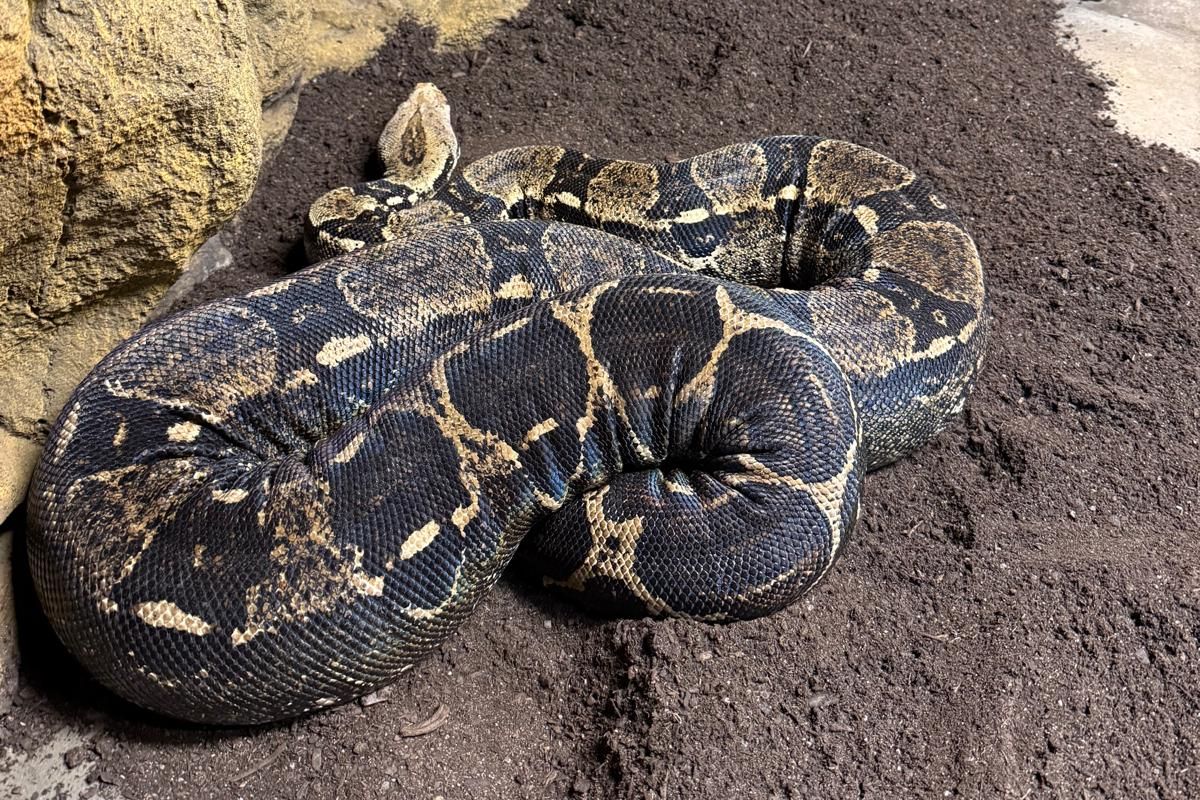
Rocky, Plumpton Park Zoo’s red-tailed boa, coiled on soil in the habitat

Rocky, our red-tailed boa.

For teachers and homeschool families

A free two-page red-tailed boa fact sheet with fast facts, words to know, discussion questions and a drawing activity. Teachers may copy and share it freely as long as they credit Plumpton Park Zoo.

Printable Fact Sheet (PDF)


Field guide

How to spot a red-tailed boa

Red-tailed boas are large, heavy-bodied snakes named for the reddish-brown markings that become especially noticeable toward the tail. Their base color may be cream, tan, brown or gray, with darker saddle-shaped markings that work as camouflage. Look for a dark line from the snout to the back of the head and dark patches in front of and behind each eye.

Unlike pythons, boas have no heat-sensing lip pits, and small scales, not large plates, cover the head. Two small spurs beside the vent are leftover hind legs, larger in males.

Red-tailed boas live across most of South America, everywhere except Chile and Uruguay, and on Trinidad and Tobago, from sea level to about 6,500 feet. They use rainforest edges and clearings, dry forest, woodland, savanna, scrub, semi-desert and mangroves, often near farms and towns.

The IUCN Red List and the Reptile Database now treat most boas of Mexico and Central America as a separate species, the Central American boa (Boa imperator); CITES and older accounts still include them in Boa constrictor.

Sources: Animal Diversity Web: Boa constrictor; U.S. Geological Survey: Giant Constrictors (Reed & Rodda 2009); IUCN Red List: Boa constrictor (assessed 2014, published 2021); IUCN Red List: Boa imperator (2018); Reptile Database: Boa constrictor; Reptile Database: Boa imperator; CITES Species+: Boa constrictor.


At a glance

Red-tailed boa fast facts

Scientific nameBoa constrictor
FamilyBoidae (boas)
Native rangeMost of South America, plus Trinidad and Tobago
HabitatRainforest edges, dry forest, savanna, scrub and mangroves
DietMostly small mammals and birds
LengthMost adults about 6–10 ft; the longest about 13 ft
WeightHeaviest females reported: about 77 lb
LifespanOften 25–35 years in human care (record just over 40)

Size varies by sex, locality and subspecies, and island boas are often smaller. Adult Argentine boas average about 9 to 13 pounds. There are no lifespan records for wild boas, though one estimate is about 20 years.

Sources: Reptile Database: Boa constrictor; IUCN Red List: Boa constrictor (assessed 2014, published 2021); Animal Diversity Web: Boa constrictor; U.S. Geological Survey: Giant Constrictors (Reed & Rodda 2009).


27

Kinds of snakes in Maryland, and not one is a boa

Closer to home

No boas in Maryland

Maryland’s Department of Natural Resources counts 27 snake species and subspecies in the state, and not one is a boa: two are vipers (the copperhead and timber rattlesnake) and 25 are colubrids, such as the red cornsnake.

Even the central ratsnake, which the department calls “our largest snake,” usually measures 42 to 72 inches; most adult boa constrictors are 6½ to 10 feet. Most boas live where average monthly temperatures generally stay above 59°F (15°C).

Sources: Maryland Department of Natural Resources: Snakes of Maryland; Maryland Department of Natural Resources: Central Ratsnake; Animal Diversity Web: Boa constrictor; U.S. Geological Survey: Giant Constrictors (Reed & Rodda 2009).


Ambush hunter

How a red-tailed boa hunts

Boas can be active by day or night, often at dusk and after dark, and temperature shapes when they move. Young boas are especially good climbers; adults spend more time on the ground, sometimes in mammal burrows, but still climb.

A boa relies on scent: its forked tongue carries scent particles to the vomeronasal organ in the roof of its mouth, and because the tongue is forked it samples two points at once, helping a snake follow a trail.

Boas are nonvenomous ambush predators. Rather than chasing prey over long distances, a boa usually waits at a burrow, trail or branch until an animal comes within striking range, then seizes it with its mouth and wraps it in muscular coils. The squeeze quickly stops the prey’s blood flow, and boas adjust their grip in response to the prey’s heartbeat.

  • Tongue: forked, to follow a scent trail
  • Coils: squeeze until blood flow stops
  • Climbing: young boas climb especially well
  • Venom: none at all

Sources: IUCN Red List: Boa constrictor (assessed 2014, published 2021); Animal Diversity Web: Boa constrictor; U.S. Geological Survey: Giant Constrictors (Reed & Rodda 2009); Schwenk 1994, Science; Boback et al. 2015, Journal of Experimental Biology; Boback et al. 2012, Biology Letters.

On the menu

What red-tailed boas eat

Red-tailed boas are carnivores. Wild boas eat mostly small mammals, including bats, and birds, plus lizards, snakes and other animals small enough to swallow. Younger snakes generally take smaller prey, while large adults can handle larger mammals and birds.

Boas swallow prey whole: the tips of the lower jaw are not fused, and stretchy tissue between them lets the mouth open around large prey. Boas are infrequent feeders, and one meal takes four to six days to digest. In some areas boas help control rodents and opossums.

Sources: Animal Diversity Web: Boa constrictor; U.S. Geological Survey: Giant Constrictors (Reed & Rodda 2009); IUCN Red List: Boa constrictor (assessed 2014, published 2021); Close et al. 2014, Journal of Experimental Biology.


Family life

Born live

4–6months of pregnancy
~25babies in a typical litter
~20 in.long at birth

Unlike many reptiles that lay eggs, red-tailed boas are live-bearing. The babies develop inside the mother, who provides them with nutrients, and they are born fully formed and independent within minutes. Many females breed only every other year or less often, depending on their condition.

Boas can even have babies without a father. In 2010, North Carolina State University scientists reported a female boa constrictor whose two litters carried no genes from a male, even though males were present. Every baby was female. It was the first virgin birth ever documented in a boa.

Sources: Animal Diversity Web: Boa constrictor; IUCN Red List: Boa constrictor (assessed 2014, published 2021); U.S. Geological Survey: Giant Constrictors (Reed & Rodda 2009); North Carolina State University (2010).


Spot the difference

How to tell our snakes apart

Red-tailed boa

Boa constrictor. Heavy-bodied, cream to tan, with dark saddles that redden toward the tail. Small head scales, no lip pits, live-born young.

Ball python

A smaller African snake, about 3 to 6 feet, that lays eggs and curls into a ball when threatened. Like other pythons, it has heat-sensing lip pits. Meet our ball python.

Corn snake

A slender, egg-laying Maryland native, usually 30 to 48 inches, with black-edged red or orange blotches and a checkerboard belly. Large plate-like scales cover its head. Meet our corn snake.

Yellow anaconda

A wetland snake from southern South America, strongly yellow with black blotches and five dark head stripes. Its eyes and nostrils sit higher on its head than a boa’s. Also at Plumpton Park Zoo.

Sources: Animal Diversity Web: Boa constrictor; Animal Diversity Web: Python regius; Animal Diversity Web: Pantherophis guttatus; Animal Diversity Web: Eunectes notaeus; U.S. Geological Survey: Giant Constrictors (Reed & Rodda 2009); Maryland Department of Natural Resources: Red Cornsnake; Maryland Department of Natural Resources: Snakes of Maryland.


Conservation

Red-tailed boas in the wild

Least Concern

The IUCN Red List rates the red-tailed boa as Least Concern because it is very widespread and its population is presumed large; the 2014 assessment, published in 2021, is flagged for updating. Numbers are falling in some areas, where habitat loss, farming, oil and gas drilling, mining, persecution and collection for the skin and pet trades take a toll.

International trade is regulated under CITES: Appendix II for Boa constrictor and Appendix I for the Argentine boa (B. c. occidentalis). Responsible care, lawful sourcing and protection of native habitats all matter to the species’ future.

Sources: IUCN Red List: Boa constrictor (assessed 2014, published 2021); CITES Species+: Boa constrictor; CITES Species+: Boa constrictor occidentalis; Animal Diversity Web: Boa constrictor.


Support

Help care for Rocky & the animals of Plumpton Park

As a nonprofit zoo, Plumpton Park Zoo relies on admissions, memberships and the generosity of people who believe in what we do. Donations help support animal care, veterinary services, nutritious diets, enrichment, habitat improvements and the continued development of the zoo.

Support Our Animals

Plumpton Park Zoological Gardens, Inc. is a 501(c)(3) nonprofit organization. Donations support the zoo’s charitable mission and are tax-deductible to the extent permitted by law.


Questions

Frequently asked questions about red-tailed boas

Are red-tailed boas venomous?

No. Boas have no fangs or venom, only rows of curved teeth. They subdue prey through constriction.

Do boas crush their prey?

Not exactly. Constriction mainly stops blood flow: in a 2015 study, a boa’s squeeze halved its prey’s blood pressure within six seconds. The snake responds to the prey’s heartbeat as it maintains pressure and lets go soon after the heartbeat stops.

Can red-tailed boas climb?

Yes. Young boas are particularly capable climbers, while larger adults spend more time on the ground.

How big do red-tailed boas get?

Size varies by sex, locality and subspecies. Many adults are roughly 6½ to 10 feet long, island boas are often smaller, and the longest reach about 13 feet.

Do red-tailed boas lay eggs?

No. Babies develop inside the mother for four to six months and are born about 20 inches long, ready to live on their own.

Where can I see a red-tailed boa in Maryland?

At Plumpton Park Zoo in Rising Sun, Cecil County, Maryland, home to Rocky, our red-tailed boa. See Hours and Tickets for times and admission.

Sources: Animal Diversity Web: Boa constrictor; Boback et al. 2015, Journal of Experimental Biology; Boback et al. 2012, Biology Letters; IUCN Red List: Boa constrictor (assessed 2014, published 2021); U.S. Geological Survey: Giant Constrictors (Reed & Rodda 2009).


See Rocky at Plumpton Park Zoo

Meet Rocky and discover more than 200 animals in Rising Sun, Maryland.

The zoo is in Cecil County, an easy drive from Delaware and southern Pennsylvania. Explore our ball python, corn snake, Aldabra giant tortoises and Animal Learning Center, and feed a giraffe.