Endangered · Feed a giraffe

Reticulated Giraffe

Giraffa reticulata

The tallest animal on earth lives in Rising Sun, Maryland. Plumpton Park Zoo is home to three reticulated giraffes, Kazar, Jill and Asha, and every day you can stand at the feeding station and hand one of them a branch.

Kazar, Jill and Asha, the three reticulated giraffes at Plumpton Park Zoo, walking across their yard in Rising Sun, Maryland
Height15–19 ft
Weight1,540–2,425 lb
TongueAbout 18 in
At Plumpton Park3 giraffes

Kazar, Jill & Asha’s story

Meet Kazar, Jill and Asha

The three reticulated giraffes who live at Plumpton Park Zoo in Rising Sun, Maryland.

KazarJillAshaReticulated giraffes

Kazar, Jill and Asha are Plumpton Park Zoo’s three reticulated giraffes and, for many families, the reason for the trip. Like all of Plumpton Park’s animals, they are cared for daily by our animal-care and veterinary teams.

Visitors do not come to Plumpton Park to see “a giraffe.” They come to see these three, and after a few visits most regulars can tell them apart by their patterns and their personalities. Every animal is an individual, and our keepers get to know each of them through daily care and observation.

Want to get closer? Feed a giraffe from our feeding platform.

For teachers and homeschool families

A free two-page reticulated giraffe fact sheet with fast facts, words to know, discussion questions and a drawing activity. Teachers may copy and share it freely as long as they credit Plumpton Park Zoo.

Printable Fact Sheet (PDF)


Field guide

How to recognize a reticulated giraffe

The reticulated giraffe, sometimes called the Somali giraffe, comes from the dry savannas and open woodlands of northern Kenya, with small populations that may remain in southern Somalia and Ethiopia. It is the easiest giraffe to recognize: large, crisp, liver-colored patches divided by narrow bright-white lines, like a net thrown over the animal. That net is where the name comes from.

The coat. Every giraffe’s pattern is as unique as a fingerprint. No two are exactly alike, which is how researchers tell individuals apart in the wild, and how our keepers can tell Kazar, Jill and Asha apart from across the yard.

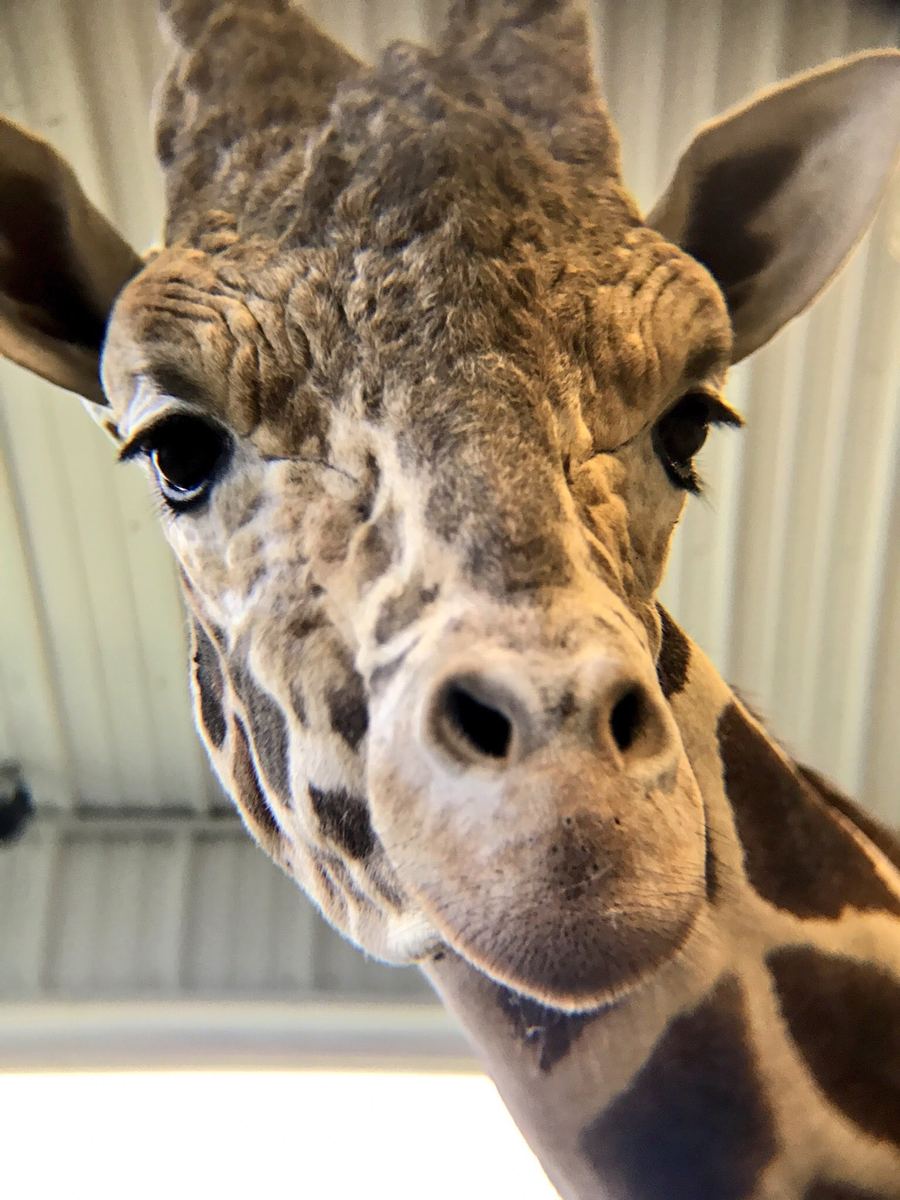
Close-up of a reticulated giraffe at Plumpton Park Zoo with two more giraffes behind it on the grass

One of our giraffes up close, with two more behind on the grass.


Kazar, a reticulated giraffe at Plumpton Park Zoo, with the dark tongue out inside the giraffe building

Kazar showing off the dark tongue. Ossicones, long lashes and the netted coat that gives the reticulated giraffe its name.

Built for the treetops

How a giraffe is put together

Everything about a giraffe is arranged around reaching food nothing else can. Its chief distinguishing characteristics are the extremely long neck and legs, the horn-like ossicones on top of the head, and that netted coat. Despite the length of the neck, a giraffe has the same seven neck vertebrae as almost every other mammal, including you; each one is simply enormous.

The heart. A giraffe’s heart has to push blood roughly six feet uphill to the brain, so its blood pressure is about twice that of a human’s. When the animal lowers its head to drink, all that pressure would rush the other way, so the blood vessels in the neck carry a system of one-way valves and elastic walls that close as the head goes down and keep the giraffe from passing out when it comes back up.

The tongue. A giraffe’s tongue is around a foot and a half long and dark purple to nearly black at the tip. The dark color is thought to protect it from sunburn during the hours spent feeding in full sun, and it is tough enough to strip leaves from thorny acacia branches without harm. You will see it in action at the feeding station.

The ossicones. The knobs on the head are not true horns or antlers. They are bone covered in skin and fur, present from birth (folded flat, so they do not hurt the mother) and growing thicker with age. Males often wear the tops bald from sparring with their necks.


At a glance

Reticulated giraffe fast facts

Scientific name Giraffa reticulata
Also called Somali giraffe
Family Giraffidae
Diet Browser: leaves, flowers, seed pods, fruit
Native range Northern Kenya; possibly southern Somalia and Ethiopia
Height 15 to 19 feet
Weight 1,540 to 2,425 lb
Tongue About 18 inches, dark purple-black
Lifespan Roughly 20 to 25 years in the wild; Jimmie reached 26½ here
Conservation status Endangered (IUCN, 2018)

26½

years: Jimmie’s age in 2021, when he was the oldest living male reticulated giraffe in the world.

Close-up of Jimmie the giraffe in the barn at Plumpton Park Zoo

Close to home

Remembering Jimmie

No page about our giraffes would be complete without Jimmie. He came to Plumpton Park Zoo from the Phoenix Zoo as a young calf in 1996 and lived here for 25 years, becoming one of the zoo’s most beloved animals along the way. By the time he passed in November 2021 at the age of 26½, Jimmie was the oldest living male reticulated giraffe in the world.

He was euthanized after a long battle with chronic hoof and leg problems that veterinarians agreed could no longer be managed; Nick Lacovara, who manages the zoo, said at the time that “it was time to end the progression of his discomfort.” Jimmie was a fixture of countless visits and a true family member to zoo staff, and he is still missed.

Read Jimmie’s full story, including the 2003 photograph of a young visitor feeding him who later became his veterinarian.


A day in the life

How a giraffe spends its day

An adult giraffe can spend most of the daylight hours eating, which is why almost any visit will find ours browsing, walking or watching visitors with quiet curiosity.

They are famously light sleepers, getting by on as little as thirty minutes to two hours of sleep a day, usually in short standing naps. Now and then a giraffe will lie down and curl its neck back over its body for a deeper rest, but not for long. Standing up is slow work for an animal this tall, and in the wild a giraffe on the ground is a giraffe at risk.

Watch for the long eyelashes, the way a giraffe splays its front legs to reach the ground, and the surprisingly gentle way it wraps its tongue around a branch.

Giraffes were long thought to be nearly silent, but they hum. Researchers recorded nearly 1,000 hours of sound at three European zoos and found low humming calls, made only at night. What the hum means is still unknown.

Source: Baotic, Sicks & Stoeger (2015), BMC Research Notes.

On the menu

What giraffes eat

Giraffes are browsers. In the wild they feed on acacia leaves, along with other leaves, flowers, seed pods and fruit, and where the savanna floor is salty or rich in minerals they will eat soil as well.

At the feeding station here, a keeper hands out browse from Memorial Day through Labor Day, and lettuce at other times of year.


Family life

Raising a giraffe calf

400–460days of gestation
6 fttall at birth
1 houruntil the calf stands and walks

A giraffe calf arrives in dramatic fashion: it falls about six feet to the ground, hooves and head first. The drop breaks the amniotic sac, severs the umbilical cord and, most importantly, encourages the calf to take its first breaths. An average calf weighs 100 to 150 pounds and stands about six feet tall. Within about an hour it is up and walking, which it has to do in order to nurse, and it will nurse from its mother for 9 to 12 months.

Source: Peoria Zoo, Giraffe Birth FAQs.


Up close

Feed a giraffe at Plumpton Park Zoo

Feeding a giraffe is about as close as most people will ever get to one. Our giraffe feeding station runs at 12:00 noon on weekdays and 11:00am and 1:00pm on weekends for most of the year, and at 11:00am and 1:00pm every day from Memorial Day through Labor Day. Feedings do not take place when the temperature is below 50°F or in inclement weather, and on a blustery day the giraffes may decide they would rather not come over; that is their call to make.

A keeper hands out browse from Memorial Day through Labor Day, and lettuce at other times of year, on a raised platform that is wheelchair accessible, so everyone in the family can take a turn. Feeding costs $5 and needs no booking; just be at the station a few minutes early. If feeding is the part of the day your family is coming for, plan the visit around it rather than hoping to catch them later.

Everything you need to know about giraffe feeding, including what to expect and how it works with school and group visits.

Visitor in a wheelchair feeding a giraffe from the accessible platform at Plumpton Park Zoo

The feeding platform is wheelchair accessible.


Spot the difference

Reticulated giraffe or another giraffe?

Reticulated giraffe

Rich orange-brown patches outlined by a network of white lines that runs down the legs. Lives mostly in northern and northeastern Kenya. Kazar, Jill and Asha are reticulated giraffes.

Masai giraffe

Large, dark-brown patches with jagged edges, shaped like vine leaves. Central and southern Kenya and throughout Tanzania.

Northern giraffe

Large, rectangular chestnut-brown patches on a creamy background, with no markings on the lower legs. Western, Central and Eastern Africa.

Southern giraffe

Large, irregular, notched brown patches on a light tan background, with spots running down the legs. Throughout Southern Africa.

The giraffe’s closest living relative looks nothing like it: the okapi, a forest animal of the Democratic Republic of the Congo with a velvety reddish-brown coat, white stripes on its legs and a long, dark, prehensile tongue of its own.

Sources: Giraffe Conservation Foundation; Animal Diversity Web (University of Michigan); IUCN SSC Giraffe and Okapi Specialist Group.


Conservation

Reticulated giraffes and conservation

ENDANGERED

The reticulated giraffe was added to the IUCN Red List of Threatened Species as Endangered in 2018. The Giraffe Conservation Foundation puts the wild population at roughly 21,000, down more than 40 percent from an estimated 36,000 thirty-five years ago. The pressures are the familiar ones: habitat loss as rangeland is converted and fenced, poaching, and years of civil unrest across parts of the range that made protection difficult.

For a long time all giraffes were treated as one species with several subspecies, and the sign at our giraffe building still carries the older name Giraffa camelopardalis reticulata. In August 2025 the IUCN formally recognized four giraffe species, and the reticulated giraffe is now its own species, Giraffa reticulata. That matters for conservation because an endangered species draws protection that an endangered subspecies often does not.

Giraffes in human care help people understand a species many did not realize was in trouble; the phrase “silent extinction” was coined for giraffes precisely because their decline went unnoticed for so long. In Africa, community conservancies that protect giraffe rangeland in northern Kenya are among the most effective ways to help wild herds.


Zoo keeper with greens beside a reticulated giraffe at Plumpton Park Zoo

A keeper with browse at the giraffe building.

Daily care

Caring for giraffes at Plumpton Park

Kazar, Jill and Asha are looked after by trained zookeepers, including keepers with four-year degrees, and an on-staff veterinarian. They live at the Edward C. Plumstead Giraffe Conservation Center, named for the zoo’s founder, whose own giraffe is remembered on the Jimmie the Giraffe page.

Our animal-care team provides nutrition, veterinary oversight, enrichment and daily behavioral observation designed to support each giraffe’s physical and behavioral well-being. Keepers monitor appetite, movement and behavior every day so subtle changes can be identified early. With an animal that carries this much weight on long legs, hoof and leg health gets particular attention. Enrichment gives the giraffes choices and problems to solve, and gifts marked for enrichment go directly to that work; see our animals page for how it is spent.


Support

Help care for Kazar, Jill, Asha & the animals of Plumpton Park

Standing eye to eye with a giraffe is a memorable part of a visit to Plumpton Park Zoo. Caring for three animals this size, and for every animal that calls Plumpton Park home, is a commitment we make every day of the year.

As a nonprofit zoo, Plumpton Park Zoo relies on admissions, memberships and the generosity of people who believe in what we do. Donations help support animal care, veterinary services, nutritious diets, enrichment, habitat improvements and the continued development of the zoo.

Your gift, at any level, helps us provide exceptional care today while building an even better Plumpton Park Zoo for the future.

Adopt Kazar. Sponsor Kazar’s care for a full year, from $50 to $1,000. Every adoption comes with an adoption certificate, a fact sheet, a 4×6 photo and a thank-you note from Kazar. Higher levels add a zoo magnet, a plush, a T-shirt, a painting by Kazar, an animal encounter with Kazar, a behind-the-scenes tour and your name on the Adoption Board. Compare the five adoption levels.

Adopt Kazar Support Our Animals

Join the herd. Become a monthly supporter of animal care at Plumpton Park Zoo: give monthly (choose “Monthly” on the form).

Plumpton Park Zoological Gardens, Inc. is a 501(c)(3) nonprofit organization. Donations support the zoo’s charitable mission and are tax-deductible to the extent permitted by law.

Two visitors holding up browse for a giraffe to eat at Plumpton Park Zoo feeding station

Visitors holding up browse at the feeding station.


Questions

Frequently asked questions about giraffes

Are reticulated giraffes endangered?

Yes. The reticulated giraffe has been listed as Endangered by the IUCN since 2018. Roughly 21,000 remain in the wild, mostly in northern Kenya, down from about 36,000 a few decades ago.

How tall is a giraffe?

Adult males commonly stand around sixteen to eighteen feet at the top of the head, and females a few feet shorter. A newborn calf is already about six feet tall.

Why is a giraffe’s tongue black?

The dark purple-black color is thought to protect the tongue from sunburn during the hours a giraffe spends feeding in full sun. The tongue is about eighteen inches long and tough enough to handle thorny acacia.

How do giraffes sleep?

Mostly standing up, in short naps totaling only a few hours a day. They will occasionally lie down and curl the neck back over the body for a deeper rest, but not for long.

Can I feed the giraffes at Plumpton Park Zoo?

Yes. Giraffe feeding runs at 12:00 noon on weekdays and 11:00am and 1:00pm on weekends for most of the year, and at 11:00am and 1:00pm every day from Memorial Day through Labor Day, from a wheelchair-accessible platform. Feedings are cancelled below 50°F or in inclement weather. It costs $5 and needs no booking. See the giraffe feeding page for details.

Where can I see giraffes in Maryland?

At Plumpton Park Zoo in Rising Sun, Cecil County, Maryland, home to three reticulated giraffes, Kazar, Jill and Asha. The zoo is open every day; see Hours and Tickets for times and admission.


See Kazar, Jill and Asha at Plumpton Park Zoo

Three reticulated giraffes, a feeding station where you can hand one of them a branch, and a zoo small enough that you are never watching from across a crowd. All of it in Rising Sun, Maryland.

The zoo is in Cecil County, an easy drive from Delaware and southern Pennsylvania. While you are here, meet Kimba and Jaala, our white lions, Brooke and Sid, our sloths, see our tigers, and the rest of our mammals.