Animal Learning Center · Not currently at the zoo

Silver Fox

Vulpes vulpes

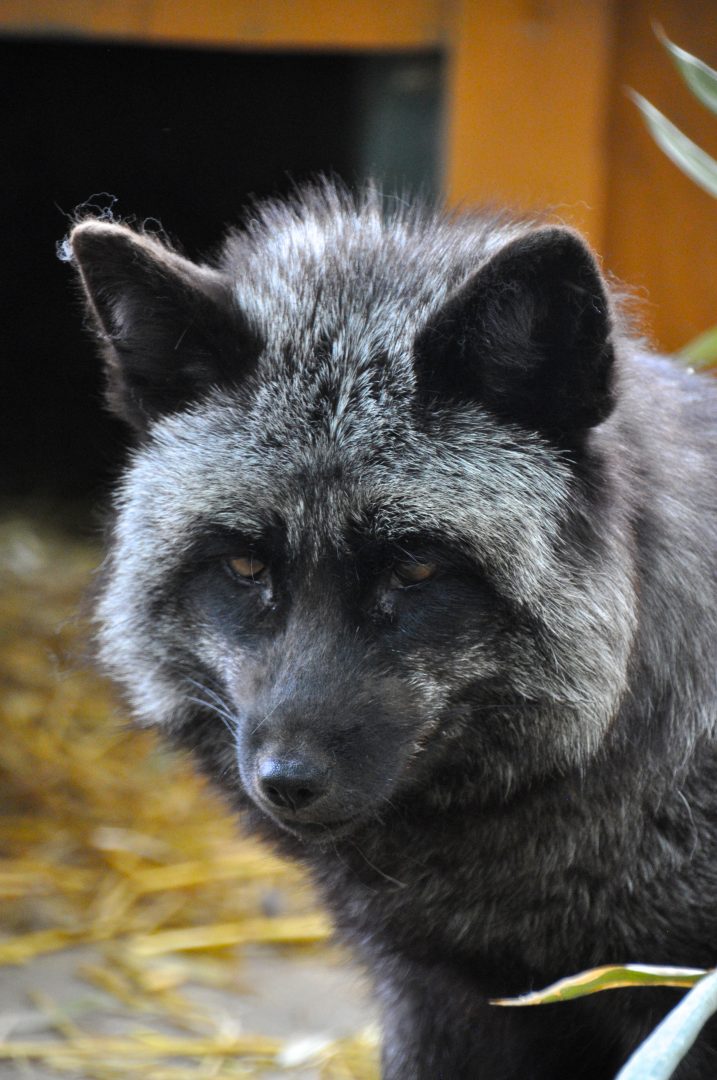
A red fox in a black-and-silver coat, and the animal at the center of a famous experiment in taming.

A silver fox with a frosted black-and-gray coat and upright ears
Size18–35 in long
Weight7–31 lb
LifespanAbout 3 years
Conservation statusLeast Concern

Animal Learning Center

Learn About the Silver Fox

A silver fox is a red fox in a different coat.

MammalDog familyNot currently at the zoo

A silver fox is not a separate species. It is a red fox, Vulpes vulpes, with a gene change that darkens its fur. Its coat can run from nearly black to a frosted silver, and like other red foxes it usually has a white tip on its tail.

Silver foxes hunt, raise pups and behave just like their orange relatives, and the two colors can even be born in the same litter. They are uncommon: by one estimate, only about one red fox in ten has a silver coat.

A note for visitors: silver foxes are not currently at Plumpton Park Zoo. This profile is part of our online Animal Learning Center, so you can keep learning about the species. When you visit, see two of its wild cousins in the dog family, the Arctic wolf and the black-backed jackal.

Sources: Animal Diversity Web (University of Michigan); Maryland DNR: The Red Fox; OMIA: agouti coat color in the red fox.

For teachers and homeschool families

A free two-page silver fox fact sheet with fast facts, words to know, discussion questions and a drawing activity. Teachers may copy and share it freely as long as they credit Plumpton Park Zoo.

Printable Fact Sheet (PDF)

Field guide

Where do silver foxes live?

Silver foxes can turn up wherever red foxes live, and red foxes live almost everywhere. The species has the widest range of any member of the dog family, across much of the Northern Hemisphere from the Arctic Circle to Central America, the steppes of central Asia and northern Africa. People have also brought red foxes to Australia.

Red foxes use forests, tundra, prairie, desert, mountains, farmland and towns, from sea level to about 14,800 feet. They do best in mixed country with plenty of edges, such as brush and woodland next to open ground.

Red foxes are native to Maryland, where open fields, small woodlots and wetlands make excellent fox habitat. They also live in the state’s suburbs and towns.

Sources: Animal Diversity Web (University of Michigan); Maryland DNR: The Red Fox.

Did you know?

Settlers brought foxes, too

Red foxes are native to Maryland, but early settlers are said to have brought more red foxes over from Europe so they could hunt them with hounds.

Not a tree climber

Maryland’s other wild fox, the gray fox, readily climbs trees. Red foxes, silver ones included, cannot.

Sources: Maryland DNR: The Red Fox; Maryland DNR: Gray Fox.

At a glance

Silver fox fast facts

Scientific name Vulpes vulpes (red fox)
Animal group Mammal — dog family (Canidae)
Native range Much of the Northern Hemisphere, south to Central America and northern Africa
Habitat Forest, tundra, prairie, desert, mountains, farmland and towns
Diet Rodents, rabbits, birds, snakes, insects, berries and fruit
Length 18–35 in, plus a 12–22 in tail
Weight About 7–31 lb
Litter size 4 or 5 pups on average
Lifespan About 3 years on average in the wild; 10–12 years in human care
Conservation status Least Concern (IUCN)

Sources: Animal Diversity Web (University of Michigan); Maryland DNR: The Red Fox.

1959

the year scientists in Siberia began breeding silver foxes for one trait: friendliness.

A famous experiment

The silver foxes that began to act like dogs

In 1959, scientists at the Institute of Cytology and Genetics in Novosibirsk, Siberia, started with 130 farm-raised silver foxes and bred them for a single trait: how calm and friendly they were toward people. In every generation, only the tamest foxes were allowed to have pups.

By the tenth generation, 18 percent of the foxes were extremely tame. The tame pups whimpered for attention and sniffed and licked people’s hands like puppies, and some wagged their tails. Over the generations, some foxes also grew floppy ears, curly tails, spotted coats and shorter snouts, even though no one had selected for those traits.

The study, begun by Dmitry Belyaev and carried on for decades by Lyudmila Trut, is one of the best-known experiments on how wild animals become domesticated. Scientists still debate what it shows. In 2019 one research team pointed out that the foxes’ ancestors came from fur farms on Canada’s Prince Edward Island, where foxes had been bred since at least the 1880s, so some of their tameness may have come with them. Trut and others disagree.

Sources: Kukekova Lab, University of Illinois; Science History Institute, “Gone to the Dogs” (2018); Science News (2019).

Behavior

How does a fox catch a mouse?

Red foxes, silver ones included, hunt mostly at night and around dawn and dusk. To catch mice hidden in tall grass or under snow, a fox makes a high leap and comes down on its prey from above.

In a 2011 study of 592 hunting jumps by wild red foxes in the Czech Republic, jumps aimed toward the north succeeded about 72 percent of the time in tall cover or snow, while jumps in most other directions succeeded less than 18 percent of the time. The researchers suggest foxes may use Earth’s magnetic field as a kind of range finder to judge the distance to their prey.

  • Solitary: red foxes do not live in packs like wolves
  • Talkative: scientists have described 28 kinds of red fox calls
  • Planners: foxes bury extra food and are very good at finding it again
  • Home range: about 2 to 5 square miles where food is plentiful

Sources: Animal Diversity Web (University of Michigan); Červený et al., Biology Letters (2011).

On the menu

What do silver foxes eat?

Silver foxes eat what every red fox eats. They are omnivores: mostly mice and other small rodents and rabbits, plus birds, snakes and insects, with berries and fruit in season.

A red fox eats about 1 to 2 pounds of food a day. When it catches more than it needs, it buries the extra in a cache to eat later.

Sources: Animal Diversity Web (University of Michigan); Maryland DNR: The Red Fox.

Family life

Raising fox pups

51–53days of pregnancy
4–5pups in an average litter
9–14days until pups open their eyes

In Maryland, foxes mate from January through March and the pups are born in spring. Foxes usually use a den only while raising pups, and they often take over an old groundhog burrow and improve it.

Pups are born blind. They leave the den at 4 or 5 weeks, are weaned by 8 to 10 weeks and stay with their mother until fall. The father brings food to the mother but does not go into the den, and older offspring sometimes help care for the pups.

Can a red fox have a silver pup? Yes. In the most common kind, called standard silver, the dark coat comes from a recessive gene, so two red parents that both carry it can have a silver pup. A second kind, the Alaska silver, comes from a dominant change in a different gene, MC1R.

Sources: Maryland DNR: The Red Fox; Animal Diversity Web (University of Michigan); OMIA: agouti coat color in the red fox; OMIA: MC1R coat color in the red fox; Våge et al., Nature Genetics (1997).

Spot the difference

Silver fox or another fox?

Silver fox

A red fox with dark, silver-frosted fur. Its tail usually ends in a white tip.

Red fox

The same species in its familiar orange coat, with long legs and a bushy, usually white-tipped tail.

Cross fox

Another color form of the red fox: reddish brown, with a dark stripe down the back and another across the shoulders.

Gray fox

A different species that also lives in Maryland. It is grizzled gray with a black-tipped tail, and it can climb trees.

Sources: Maryland DNR: The Red Fox; Maryland DNR: Gray Fox; Animal Diversity Web (University of Michigan).

Conservation

Conservation status

LEAST CONCERN

The red fox, silver foxes included, is listed as Least Concern by the IUCN. Its populations are stable overall, and it has even expanded its range as people have changed the landscape. People who hunt and trap foxes for fur are its most significant predators, and most foxes taken by natural predators are young pups.

Fur once made the silver fox famous. In the 1890s, Charles Dalton and Robert Oulton began raising silver foxes on Prince Edward Island, Canada, starting with pups taken from wild dens, and fox farming quickly became the island’s most profitable kind of agriculture. By 1913 the island had 277 fox farms, and an adult breeding pair could sell for $18,000 to $35,000.

Sources: Animal Diversity Web (University of Michigan); The Canadian Encyclopedia: Fur Farming.

Support

Help care for the animals of Plumpton Park

As a nonprofit zoo, Plumpton Park Zoo relies on admissions, memberships and the generosity of people who believe in what we do. Donations help support animal care, veterinary services, nutritious diets, enrichment, habitat improvements and the continued development of the zoo, including free learning resources like this one.

Support Our Animals

Plumpton Park Zoological Gardens, Inc. is a 501(c)(3) nonprofit organization. Donations support the zoo’s charitable mission and are tax-deductible to the extent permitted by law.

Questions

Common questions about silver foxes

Is a silver fox a different species from a red fox?

No. A silver fox is a red fox, Vulpes vulpes, with a gene change that makes its fur dark.

Why is a silver fox black?

A change in the genes that control fur color. In standard silver foxes it is a recessive change in a gene called agouti; in Alaska silver foxes it is a dominant change in a gene called MC1R.

Can two red foxes have a silver pup?

Yes. If both parents carry the recessive gene for standard silver, some of their pups can be born silver.

How common are silver foxes?

They are uncommon. By one estimate, only about one red fox in ten has a silver coat.

What was the Siberian fox experiment?

Beginning in 1959, scientists in Novosibirsk, Siberia, bred silver foxes for tameness alone. By the tenth generation, 18 percent were extremely tame, and tame foxes whimpered, licked and wagged their tails much like dogs.

Can you keep a silver fox as a pet in Maryland?

No. Maryland law does not allow people to import, sell, trade, possess or breed a live fox, apart from narrow exceptions such as federally licensed exhibitors and research facilities (Maryland Criminal Law § 10-621).

Can I see a silver fox at Plumpton Park Zoo?

Silver foxes are not currently at Plumpton Park Zoo. This profile is part of our online Animal Learning Center. When you visit, you can see two of the silver fox’s wild cousins in the dog family, the Arctic wolf and the black-backed jackal.

Sources: Maryland Code, Criminal Law § 10-621; OMIA: agouti coat color in the red fox; OMIA: MC1R coat color in the red fox; Kukekova Lab, University of Illinois; Animal Diversity Web (University of Michigan).


Keep exploring with Plumpton Park Zoo

Continue learning about animal colors, genetics and adaptations in the Plumpton Park Zoo Animal Learning Center, or explore our mammals.

When you visit Rising Sun, see the Arctic wolf and the black-backed jackal, two wild members of the dog family, and feed a giraffe.