Two live here
♥ Rescued at Plumpton Park Zoo

Dromedary Camel

Camelus dromedarius

The one-humped camel of Arabia and North Africa, built to go for days without water. Meet Abu and Chloe, the dromedary camels of Plumpton Park Zoo in Rising Sun, Maryland.

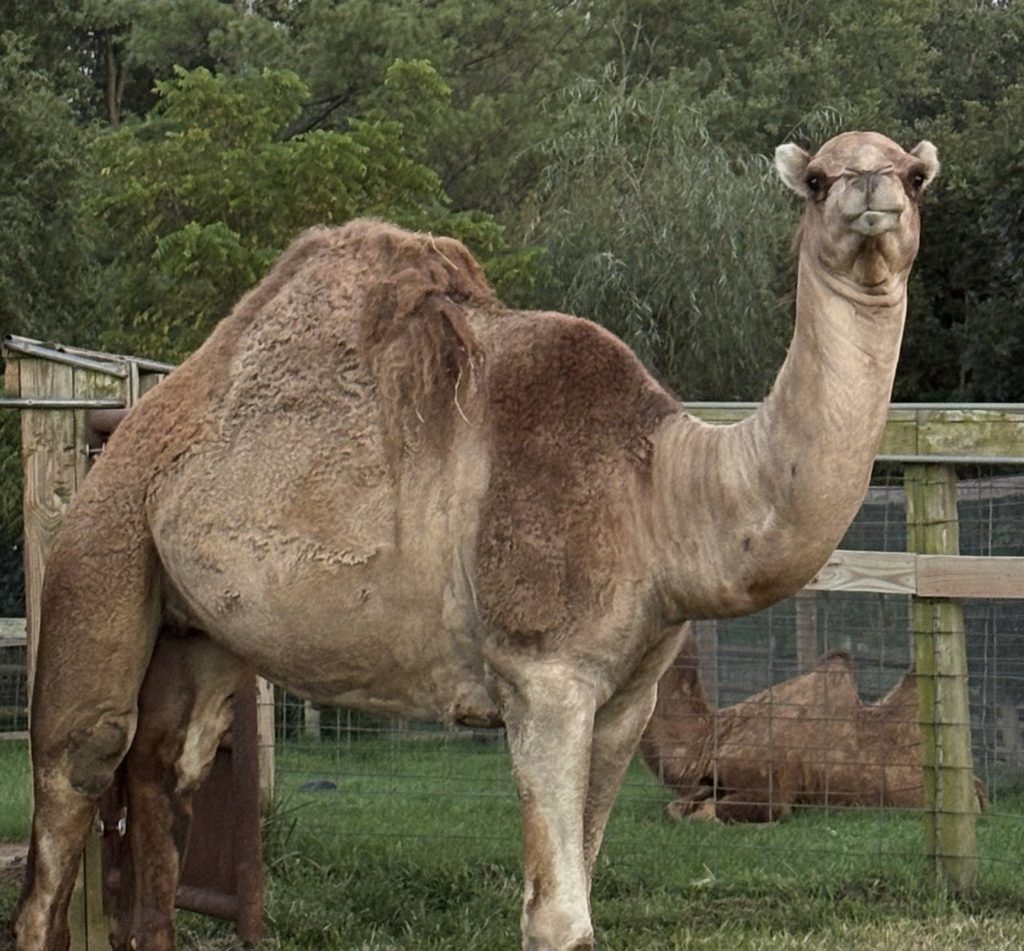
A dromedary camel standing in its paddock at Plumpton Park Zoo, looking toward the camera
SizeAbout 6 ft tall
Weight900–1,300 lb
LifespanUp to 40 years
Conservation statusDomesticated

Our camels

Meet Abu and Chloe

One hump each. Count them.

AbuChloe

Two dromedary camels live at Plumpton Park Zoo: Abu, a male, and Chloe, a female.

The dromedary is the one-humped camel of Arabia and North Africa, and the easiest way to tell it from a Bactrian camel is to count: one hump, not two. Dromedaries were domesticated roughly three thousand years ago and no longer exist in the wild anywhere in their native range, though a large feral population roams the Australian outback.

Come see Abu and Chloe, and Lilly, our Bactrian camel, for a side-by-side lesson in one hump versus two.

For teachers and homeschool families

A free two-page dromedary camel fact sheet with fast facts, words to know, discussion questions and a drawing activity. Teachers may copy and share it freely as long as they credit Plumpton Park Zoo.
Printable Fact Sheet (PDF)


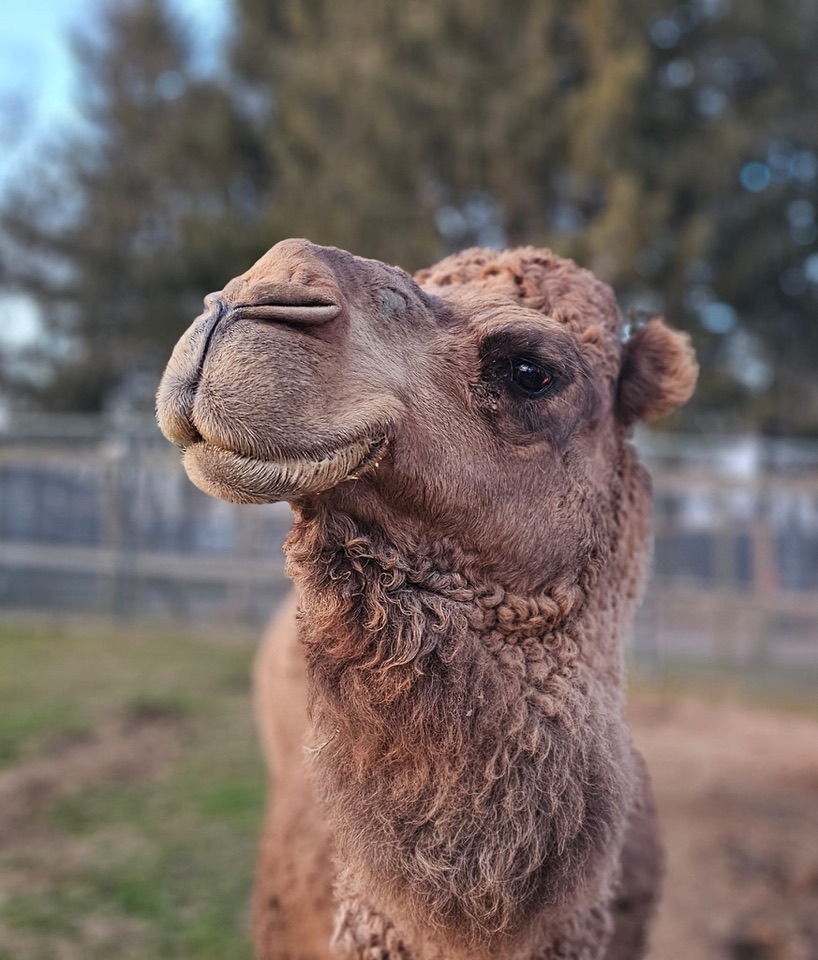
Close-up portrait of a dromedary camel at Plumpton Park Zoo

A dromedary camel at Plumpton Park Zoo.

Field guide

The hump is fat, not water

The hump stores fat, not water. A well-fed dromedary can carry a hump of up to about 85 pounds, mostly fat, drawing on that reserve when food is scarce, which is why a hungry camel’s hump shrinks and leans to one side. Keeping the fat in one place, instead of spread under the skin, also lets the rest of the body shed heat.

The water-handling is separate and just as impressive. A thirsty camel can drink around 26 gallons in ten minutes, and its oval red blood cells, round in most other mammals, keep flowing when the animal is badly dehydrated. Camels can tolerate losing water equal to more than 30 percent of their body weight; most mammals die at 15 percent. When short of water, they do not start to sweat until their body temperature reaches about 106 to 108°F, letting the heat build through the day and releasing it overnight instead of spending water to stay cool.

Sources: Köhler-Rollefson, Mammalian Species 375: Camelus dromedarius; Animal Diversity Web (University of Michigan): Camelus dromedarius; Kadim & Purchas 2019: Camel Carcass and Meat Quality Characteristics; Alhaddad et al. 2024, PLOS ONE: camel blood cells; Ouajd & Kamel 2009, Scandinavian Journal of Laboratory Animal Science: dromedary physiology; Schmidt-Nielsen 1962: Comparative Physiology of Desert Mammals.


Behind the scenes

Chloe’s weigh-in

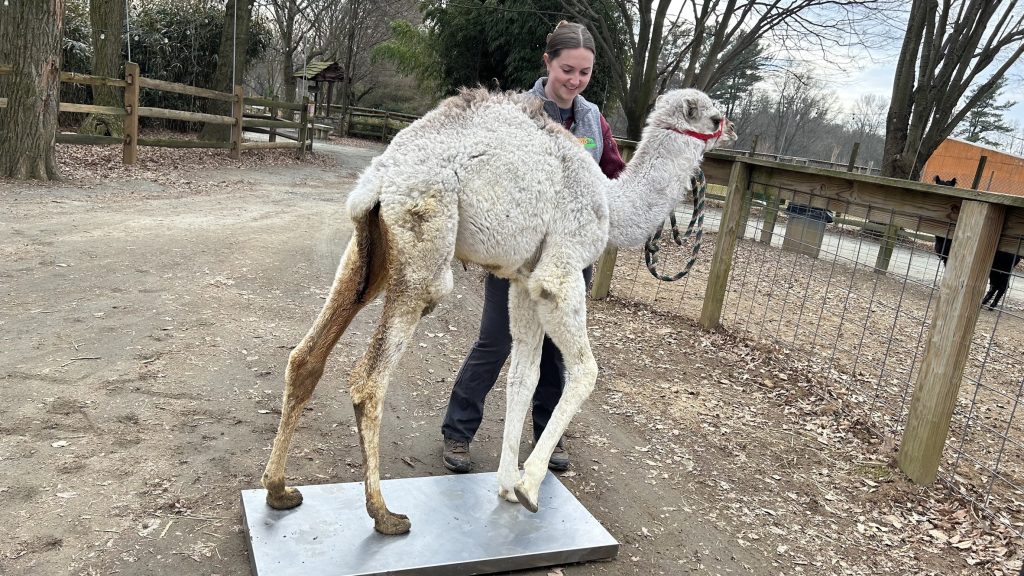
Here is Chloe as a young calf, stepping onto the scale for a weigh-in. Regular weigh-ins let keepers track how a young camel is growing. Today Chloe shares her yard with Lilly, our Bactrian camel, so visitors can compare one hump and two side by side.

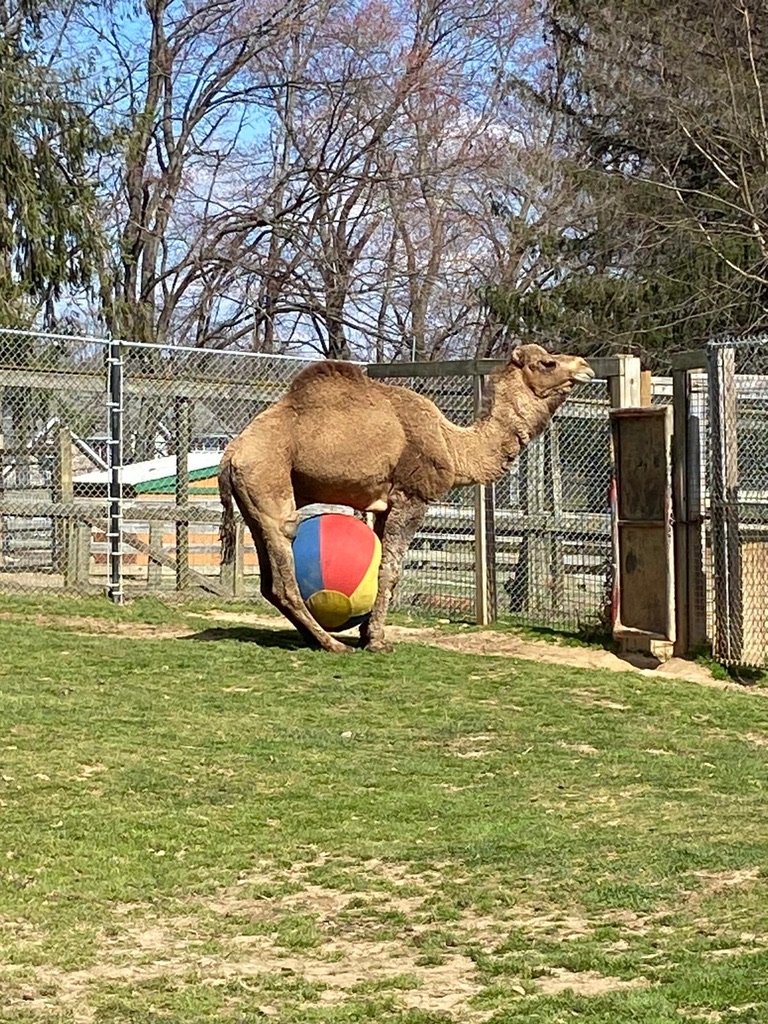
Abu is the one you may catch playing with his big ball.

Chloe as a young dromedary camel calf stepping onto a scale for a weigh-in with a keeper at Plumpton Park Zoo

Chloe as a young calf, stepping on the scale for a weigh-in.


Chloe the dromedary camel standing in her yard with Lilly the Bactrian camel resting behind her at Plumpton Park Zoo

Chloe, with Lilly the Bactrian camel resting behind her.

At a glance

Dromedary fast facts

Scientific name Camelus dromedarius
Animal group Mammal — camel family (camelids)
Native region The Arabian Peninsula; now herded across North and East Africa, the Middle East and northern India
Habitat Hot, dry deserts
Diet Grasses, leaves and twigs, including thorny, salty desert plants
Shoulder height About 6 ft; about 7 ft at the top of the hump
Weight 900 to 1,300 lb; large males up to 1,500 lb
Pregnancy 12 to 14 months
At birth About 77 lb
Lifespan Up to 40 years
Status Domesticated

Sources: Köhler-Rollefson, Mammalian Species 375: Camelus dromedarius; Animal Diversity Web (University of Michigan): Camelus dromedarius; FAO 1994: Primary animal health care manual, Ch. 7 Camels; Bene et al. 2020, Tropical Animal Health and Production: birth weight in dromedaries.


40 million+

camels worldwide, FAO says; about 97% were dromedaries in 2018.

A camel of the people

Millions of camels, almost none wild

FAO puts the world’s camels at more than 40 million, most of them in Africa, and about 97% were dromedaries in 2018. A female can give about 3.5 to 20 liters, roughly 1 to 5 gallons, of milk a day, depending on the region, and dromedaries still carry, pull and feed people across the deserts of Africa and the Middle East.

No truly wild dromedaries remain in their native range. The one big free-roaming population is in Australia, where more than 300,000 feral camels now roam the outback.

Sources: Faye 2020, Pastoralism (CIRAD): How many large camelids in the world?; FAO 2024: Supporting the camelid sector; Faraz et al. 2025, Frontiers in Veterinary Science: Barela camel milk; Köhler-Rollefson, Mammalian Species 375: Camelus dromedarius; Government of South Australia (PIRSA): Feral camels; Ninti One 2013: Australian Feral Camel Management Project final report.


Behavior

Built for sand, sun and thorns

Almost every feature of a dromedary is a desert adaptation. Slit-like nostrils close against blowing sand. Two rows of long eyelashes guard the eyes, and a prominent bony ridge above each eye adds protection. Thick lips let it browse thorny plants other animals cannot touch, and broad two-toed feet spread its weight so it does not sink into loose sand.

Camels have a reputation for spitting. What a dromedary actually does, when it is hurt or excited, is bring up some of its cud. Their front teeth wear down with age, and from about age 15 hard food becomes difficult.

Sources: Köhler-Rollefson, Mammalian Species 375: Camelus dromedarius; Animal Diversity Web (University of Michigan): Camelus dromedarius; Animal Diversity Web (University of Michigan): Camelidae; FAO 1994: Primary animal health care manual, Ch. 7 Camels.

  • One hump: up to about 85 lb, mostly fat
  • Eyelashes: two rows, to keep out sand
  • Nostrils: close tight in a sandstorm
  • Feet: broad two-toed pads that spread on sand
On the menu

What dromedaries eat

Dromedary camels are herbivores. In their native range they browse grasses, leaves and the twigs of desert shrubs and trees, including hard, thorny and salty plants most grazers avoid. A camel needs about eight times as much salt as cattle or sheep, and in a hot, dry season a thirsty camel can drink up to 200 liters, about 53 gallons, in one go.

Like cattle, camels chew cud. Microbes in the first stomach chambers partly break plants down, and the food is brought back up and chewed again. Ours are fed hay and grain along with browse.

Sources: FAO 1994: Primary animal health care manual, Ch. 7 Camels; Köhler-Rollefson, Mammalian Species 375: Camelus dromedarius; Animal Diversity Web (University of Michigan): Camelus dromedarius; Al Jassim 2022, Animal Frontiers: foregut microbiology of the Arabian camel.


Family life

Raising a camel calf

12–14 mopregnancy
~77 lbat birth
1–2 yrsto weaning

A dromedary mother carries her calf for about a year, 12 to 14 months, and gives birth to a single calf, usually every two years. Calves weigh about 77 pounds at birth, and males are larger than females. They are up and walking shortly after they are born, nurse for one to two years, and reach adulthood at three to four years for females and about six for males.

Sources: FAO 1994: Primary animal health care manual, Ch. 7 Camels; Köhler-Rollefson, Mammalian Species 375: Camelus dromedarius; Animal Diversity Web (University of Michigan): Camelus dromedarius; Bene et al. 2020, Tropical Animal Health and Production: birth weight in dromedaries.


Spot the difference

Dromedary, Bactrian or llama?

Dromedary

One hump and a short, light coat. Domesticated across North Africa, the Middle East and Arabia.

Bactrian camel

Two humps and a heavy winter coat. Meet Lilly, our Bactrian camel.

Wild Bactrian camel

A separate species from the domestic Bactrian, found in the deserts of southwest Mongolia and northwest China and listed as Endangered (IUCN, 2025).

Llamas and alpacas

The camel family’s South American cousins, with no hump at all.


Conservation

Why they matter

DOMESTICATED

Dromedaries are not endangered: FAO puts the world’s camels at more than 40 million, and about 97% were dromedaries in 2018. Because no wild population remains, they are treated as domesticated and have no special conservation status. Their relative the wild Bactrian camel is a different story; it is listed as Endangered (IUCN, 2025).

Sources: Faye 2020, Pastoralism (CIRAD): How many large camelids in the world?; FAO 2024: Supporting the camelid sector; IUCN Red List 2025: Wild Camel (Camelus ferus); Animal Diversity Web (University of Michigan): Camelus dromedarius; Köhler-Rollefson, Mammalian Species 375: Camelus dromedarius.

Abu the dromedary camel playing with a large ball at Plumpton Park Zoo

Abu playing with his ball at Plumpton Park Zoo.


Support

Help care for Abu, Chloe & the animals of Plumpton Park

As a nonprofit zoo, Plumpton Park Zoo relies on admissions, memberships and the generosity of people who believe in what we do. Donations help support animal care, veterinary services, nutritious diets, enrichment, habitat improvements and the continued development of the zoo.

Support Our Animals

Plumpton Park Zoological Gardens, Inc. is a 501(c)(3) nonprofit organization. Donations support the zoo’s charitable mission and are tax-deductible to the extent permitted by law.


Questions

Questions visitors ask about dromedary camels

How many humps does a dromedary have?

One. Bactrian camels have two.

Does a camel store water in its hump?

No. The hump stores fat. It can weigh up to about 85 pounds, mostly fat, and the camel draws on it when food is scarce.

How much water can a camel drink?

A thirsty camel can drink around 26 gallons in ten minutes, and up to about 53 gallons in one go in hot, dry weather.

Do camels spit?

When hurt or excited, a dromedary may bring up some of its cud.

How long do dromedary camels live?

Up to 40 years.

Are there wild dromedary camels?

Not in their native range. Dromedaries today are domesticated: FAO puts the world’s camels at more than 40 million, and about 97% were dromedaries in 2018. The exception is Australia, where more than 300,000 feral camels roam.

How many camels live at Plumpton Park Zoo?

Three: dromedaries Abu and Chloe, and Lilly, our Bactrian camel.

Where can I see a camel in Maryland?

At Plumpton Park Zoo in Rising Sun, Cecil County, Maryland. See Hours and Tickets for times and admission.


Meet Abu and Chloe at Plumpton Park Zoo

Our dromedary camels are part of a visit to Plumpton Park Zoo in Rising Sun, Maryland.

The zoo is in Cecil County, an easy drive from Delaware and southern Pennsylvania. While you are here, meet Lilly, our Bactrian camel, our reticulated giraffes and our Grant’s zebras.