
Animal Learning Center · Not currently at the zoo

Polar Bear

Ursus maritimus

The great white bear of the Arctic, built to hunt seals from the sea ice.

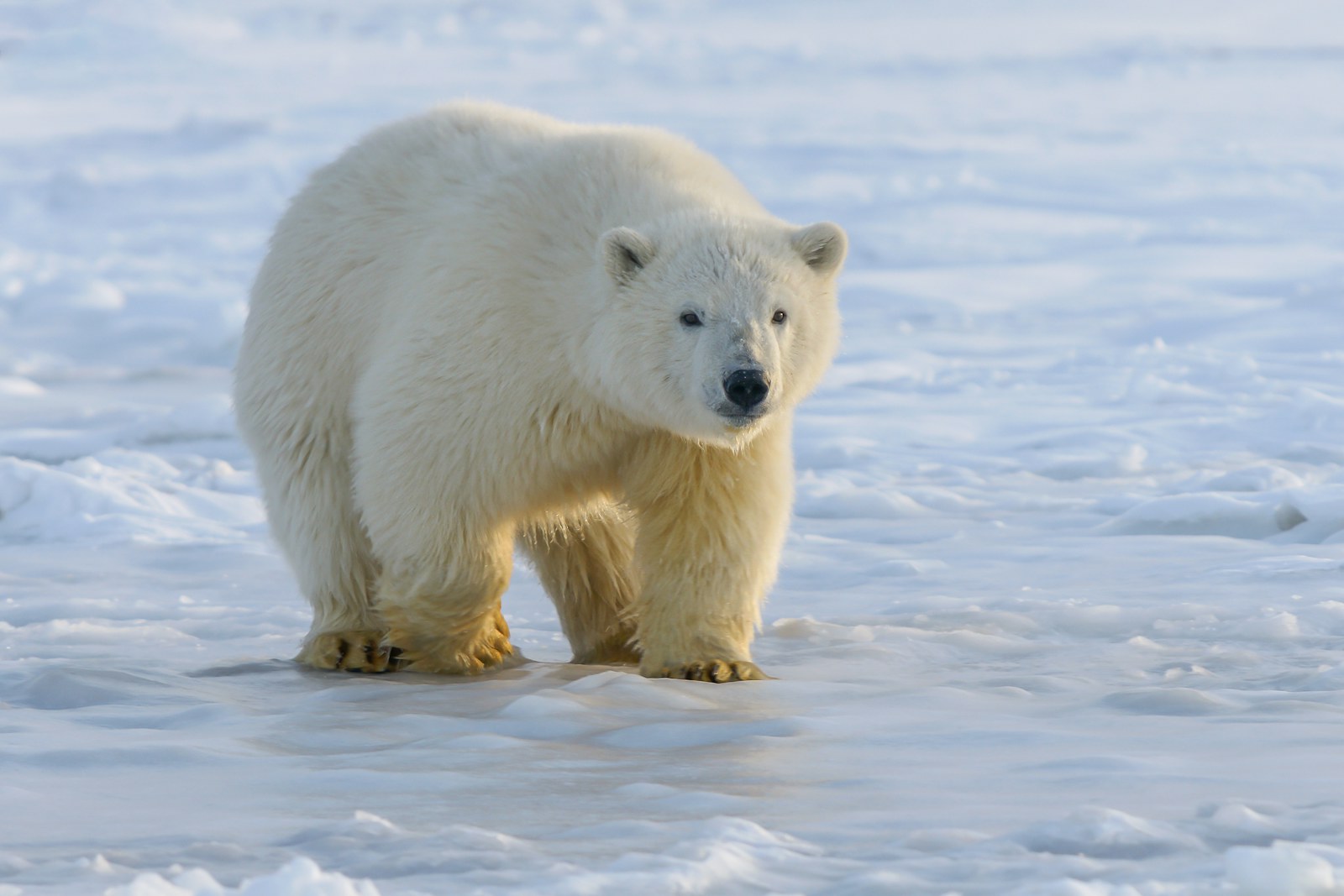
A young polar bear walking across snow-covered sea ice
Male lengthAbout 8.2 ft
Male weight660–1,540 lb
Lifespan in the wild15–25 years
Conservation statusVulnerable

Animal Learning Center

Learn About the Polar Bear

A polar bear’s skin is black.

MammalThe ArcticNot currently at the zoo

The polar bear lives around the top of the world, in the Arctic regions of Canada, Alaska, Greenland, Russia and Norway. It spends much of its life on sea ice over shallow coastal waters, where it hunts seals.

Its fur is not truly white. The hairs have no pigment and are translucent; they look whitest just after the bear molts and can turn yellowish in summer. Underneath, a polar bear’s nose and skin are black.

A note for visitors: the polar bear is not currently at Plumpton Park Zoo. This profile is part of our online Animal Learning Center, so you can keep learning about the species. When you visit, meet Frankie and Hope, our European brown bears, Louie, our American black bear, and Harley, Luna, Shadow and Thunder, our Arctic wolves.

For teachers and homeschool families

A free two-page polar bear fact sheet with fast facts, words to know, discussion questions and a drawing activity. Teachers may copy and share it freely as long as they credit Plumpton Park Zoo.
Fact Sheet, Grades K–2 (PDF)Fact Sheet, Grades 3–5 (PDF)


Field guide

Where do polar bears live?

Polar bears live all the way around the Arctic, in Canada, the United States (Alaska), Greenland, Russia and Norway. A few occasionally reach Iceland.

Most live on sea ice that forms each year over shallow coastal waters; small numbers enter the permanent pack ice of the central Arctic. Many bears move to shore in summer as the ice melts and return to the ice in autumn to hunt. As sea ice has shrunk in recent decades, bears have spent more time on land.

Did you know? Polar bears are strong swimmers that paddle with oar-like front paws. One female was tracked swimming 427 miles over nine days.

Sources: Government of Canada: COSEWIC polar bear status report 2018; Canadian Wildlife Service: Polar Bear (Hinterland Who’s Who); IUCN Red List: Ursus maritimus (Wiig et al. 2015); Durner et al. 2011, Polar Biology: long-distance swim.

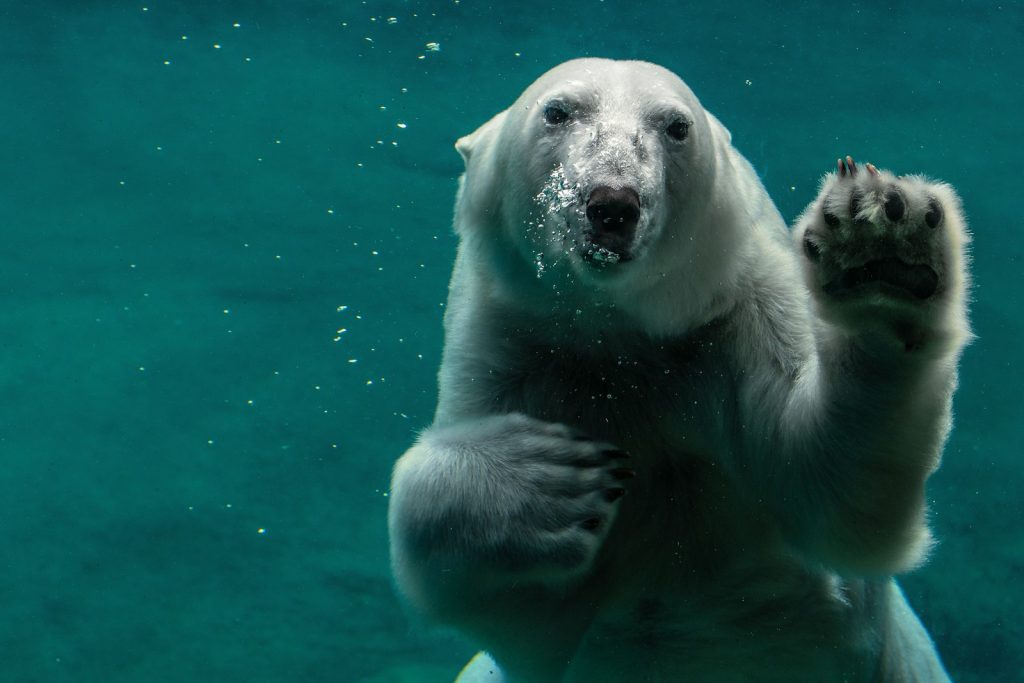
A polar bear swimming underwater with one large paw raised

A polar bear swimming. Photos on this page: Peter Neumann and Hans-Jurgen Mager on Unsplash.


At a glance

Polar bear fast facts

Scientific name Ursus maritimus
Animal group Mammal — bear family (Ursidae)
Native region The Arctic: Canada, Alaska, Greenland, Russia and Norway
Habitat Sea ice over shallow coastal waters
Diet Carnivore — mainly ringed seals
Length Females about 6 ft; males about 8.2 ft
Shoulder height Up to about 5.2 ft
Weight Females 330–770 lb; males 660–1,540 lb, very large males up to 1,760 lb
Lifespan Typically 15–25 years in the wild
Conservation status Vulnerable (IUCN)

Sources: Mammalian Species 145: Ursus maritimus (DeMaster & Stirling 1981); Norwegian Polar Institute: Polar bear; Canadian Wildlife Service: Polar Bear (Hinterland Who’s Who); IUCN Red List: Ursus maritimus (Wiig et al. 2015).


8

months a pregnant polar bear can go without food, ashore and in her den.

Family life

A mother’s long winter in the den

Before denning, a pregnant polar bear puts on a great deal of weight. In October or November she digs a den, usually in a snowdrift or slope on land. That stored fat carries her through a fast of up to eight months: in the den she does not eat or drink, and she can lose as much as 43 percent of her body weight.

Cubs are born between November and January, usually as twins. Each weighs only about 1 pound 5 ounces to 1 pound 9 ounces. The family leaves the den in March or April.

Cubs usually nurse for two years or more and stay with their mother for about two and a half years, learning how to hunt and survive. Most females raise a litter only once every three years.

Sources: Government of Canada: COSEWIC polar bear status report 2018; Canadian Wildlife Service: Polar Bear (Hinterland Who’s Who); Alaska Department of Fish and Game: Polar bear species profile; International Association for Bear Research and Management: Polar bear; Polar Bears International: Life Cycle.


Built for the Arctic

How is a polar bear built for the cold?

A polar bear wears two layers of fur: thick underfur about 2 inches long, and longer guard hairs up to about 6 inches that are hollow. Beneath its skin lies a layer of fat 2 to 4 inches thick. Together they keep the bear so well insulated that it overheats easily when it runs.

Its feet are wide and paddle-like. Small bumps on the soles may help it grip the ice, and the bottoms of its feet are nearly covered in fur. Its claws are 2 to almost 3 inches long and cannot be pulled back.

  • Black skin: under translucent fur
  • Hollow guard hairs: up to about 6 in long
  • Fat layer: 2–4 in thick
  • Bumpy soles: may grip the ice
  • Strong swimmer: paddles with its front paws

Sources: Mammalian Species 145: Ursus maritimus (DeMaster & Stirling 1981); Polar Bears International: Adaptations and Characteristics; Government of Canada: COSEWIC polar bear status report 2018; Alaska Department of Fish and Game: Polar bear species profile.

On the menu

What do polar bears eat?

Polar bears are highly carnivorous. They eat mainly the blubber and skin of ringed seals, and also harp, hooded, bearded and harbor seals. Now and then they kill walruses, belugas or narwhals, or feed on bowhead whale carcasses, along with birds, eggs and some plants.

Walking takes far more energy than resting, so polar bears prefer to wait at seal breathing holes, which they can detect from up to 0.6 mile away, perhaps farther. Most attempts fail: in a 1985 Svalbard study, only 6 of 62 attacks on seal lairs and breathing holes ended in a kill. In spring and early summer, when seals are easiest to reach, a bear may catch one every four to five days.

Sources: Canadian Wildlife Service: Polar Bear (Hinterland Who’s Who); Government of Canada: COSEWIC polar bear status report 2018; Alaska Department of Fish and Game: Polar bear species profile; Polar Bears International: Habitat; Togunov et al. 2017, Scientific Reports: olfactory foraging; Gjertz & Lydersen 1986, Polar Research: predation at Hornsund, Svalbard.


Spot the difference

Polar bear or another bear?

Polar bear

Translucent fur over black skin. Lives on Arctic sea ice and eats mainly seals.

Brown bear

Large male brown bears in coastal Alaska can sometimes rival polar bears in size. Meet Frankie and Hope, our European brown bears.

American black bear

A bear you can meet at Plumpton Park Zoo. Meet Louie, our American black bear.

Giant panda

A bear of China’s mountain forests that eats almost nothing but bamboo. Learn about the giant panda.

Sources: International Association for Bear Research and Management: Brown bear; Animal Diversity Web: Giant panda.


Conservation

Conservation status

VULNERABLE

The polar bear is listed as Vulnerable on the IUCN Red List (2015 assessment). The latest global estimate, published in 2016, is about 26,000 polar bears, and scientists now count 20 separate populations.

The main threat is a warming climate. As sea ice shrinks, polar bears lose the platform they hunt from and their access to seals. Chemical and oil pollution are also threats.

Sources: IUCN Red List: Ursus maritimus (Wiig et al. 2015); IUCN/SSC Polar Bear Specialist Group: Status report 2024; Government of Canada: COSEWIC polar bear status report 2018.


Support

Help care for the animals of Plumpton Park

As a nonprofit zoo, Plumpton Park Zoo relies on admissions, memberships and the generosity of people who believe in what we do. Donations help support animal care, veterinary services, nutritious diets, enrichment, habitat improvements and the continued development of the zoo, including free learning resources like this one.

Support Our Animals

Plumpton Park Zoological Gardens, Inc. is a 501(c)(3) nonprofit organization. Donations support the zoo’s charitable mission and are tax-deductible to the extent permitted by law.


Questions

Common questions about polar bears

Is a polar bear’s fur white?

Not exactly. The hairs have no pigment and are translucent. They look whitest after molting and can turn yellowish in summer.

What color is a polar bear’s skin?

Black, like its nose and lips.

How big do polar bears get?

Males usually weigh 660 to 1,540 pounds, and very large males up to 1,760 pounds. Females usually weigh 330 to 770 pounds.

What do polar bears eat?

Mainly ringed seals, especially their blubber and skin.

Can polar bears swim?

Yes. They paddle with their front paws, and one female swam 427 miles over nine days.

Are polar bears endangered?

They are listed as Vulnerable. The latest estimate, published in 2016, is about 26,000 in the wild, and loss of sea ice is the main threat.

Can I see a polar bear at Plumpton Park Zoo?

Polar bears are not at Plumpton Park Zoo. This profile is part of our online Animal Learning Center. When you visit, you can meet our European brown bears, our American black bear and our Arctic wolves.


Keep exploring with Plumpton Park Zoo

Continue learning about bears, animal adaptations and conservation in the Plumpton Park Zoo Animal Learning Center, or explore our mammals.

When you visit Rising Sun, meet Frankie and Hope, our European brown bears, Louie, our American black bear, and our Arctic wolves.