Plumpton Park Zoo · North American rodent
♥ Rescued at Plumpton Park Zoo

North American
Porcupine

Erethizon dorsatum

Meet Quillbert, Plumpton Park Zoo’s North American porcupine, in Rising Sun, Maryland. Discover the climbing rodent wearing about 30,000 quills.

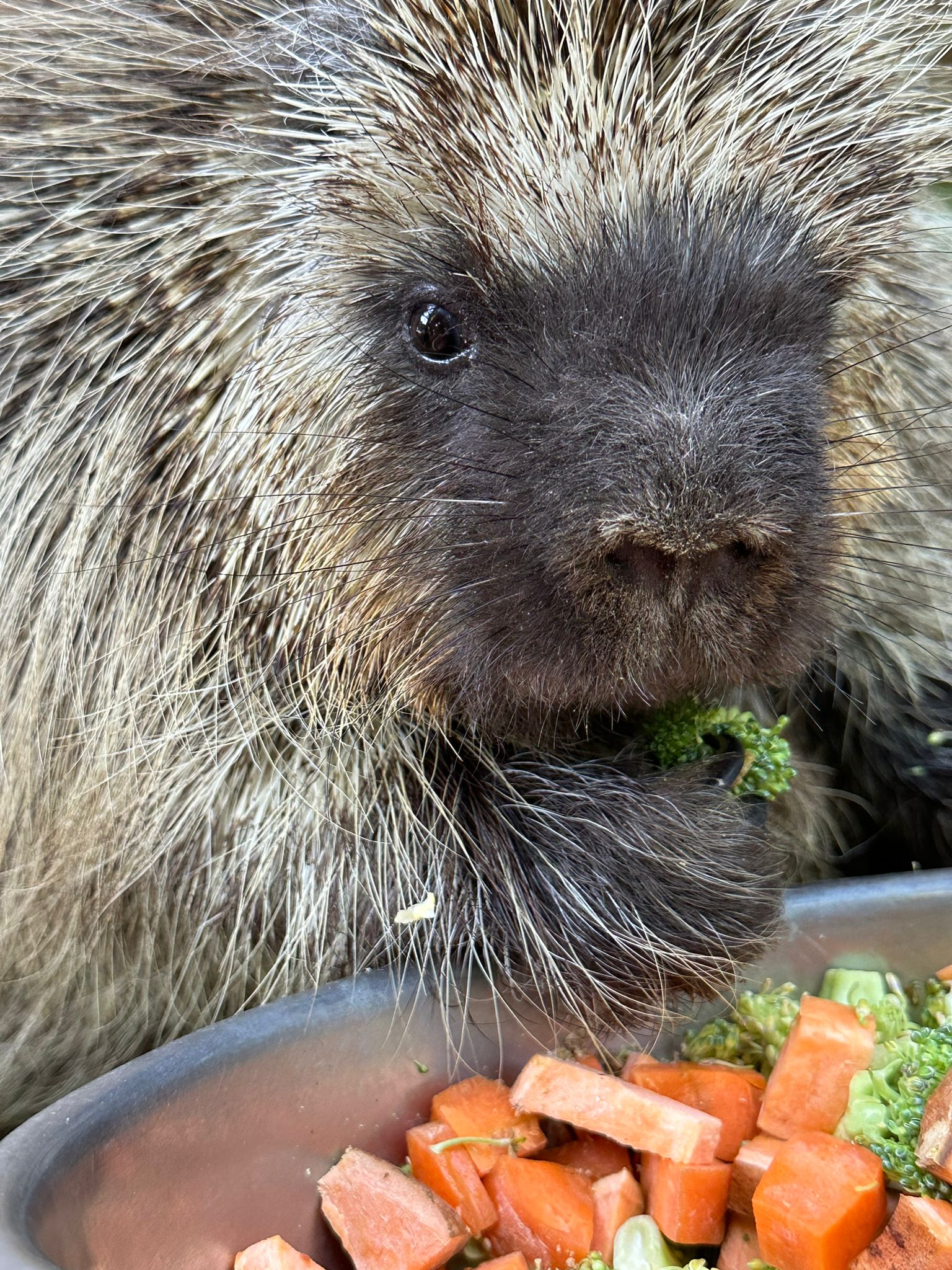
Quillbert, a North American porcupine, eating greens and carrots at Plumpton Park Zoo in Rising Sun, Maryland
OrderRodentia (rodents)
Native rangeNorth America
DietHerbivore
Meet our porcupineQuillbert

North American porcupine eating vegetables at Plumpton Park Zoo

A close look at our North American porcupine. Photo: © Plumpton Park Zoo.

Our porcupine

Quillbert

He takes his time, and so should you.

Quillbert

Quillbert is Plumpton Park Zoo’s North American porcupine.

About half of our animals are rescued, taken in from people and places that could no longer care for them.

Come see our North American porcupine at Plumpton Park Zoo — plan your visit.

Quillbert’s name appears in the zoo’s animal records.

For teachers and homeschool families

A free one-page North American porcupine fact sheet with fast facts, vocabulary, five reading questions and a drawing activity. Use quills and claws to explain survival (NGSS 4-LS1-1), and nursing to discuss parental care (1-LS1-2). Teachers may copy and share it freely as long as they credit Plumpton Park Zoo.

Printable Fact Sheet (PDF)


Field guide

A porcupine of forests and tundra

The North American porcupine is the second-largest rodent on the continent, after the beaver, and it is found from Alaska and Canada down through the western United States and the forests of the Northeast.

It has the northernmost range of any porcupine, reaching from the Arctic Ocean to northern Mexico. Besides coniferous and mixed forests, it lives in grasslands, desert shrublands and tundra.

Its fur ranges from brownish yellow to black, with white highlights in the quills.

Where a porcupine spends its time varies with habitat and food. Animal Diversity Web describes some populations as mostly ground dwelling and others as mostly tree dwelling. The climbing behavior described in our original guide is an adaptation, rather than a rule for every population.

Sources: Animal Diversity Web (University of Michigan).


At a glance

North American porcupine fast facts

Scientific nameErethizon dorsatum
OrderRodentia (rodents)
Size24–35 in including the tail
Weight11–31 lb
QuillsAbout 30,000
YoungUsually 1 porcupette
Lifespan5–7 years in the wild, up to 18 in captivity
Conservation statusLeast Concern
At Plumpton ParkQuillbert

Our original zoo guide gives a wild lifespan of 5–7 years and up to 18 in captivity. Animal Diversity Web reports that wild porcupines can live as long as 18 years. An average and a maximum describe different things.

Animal Diversity Web gives a weight range of 5 to 14 kg, about 11 to 31 lb.

Sources: Animal Diversity Web (University of Michigan).


30,000

Quills on a North American porcupine

The famous defense

How the quills work

It is covered in roughly 30,000 quills — stiff, hollow hairs with microscopic barbs at the tip. A porcupine cannot throw them; the quills simply detach on contact and work their way in, which is why most predators learn to leave a porcupine alone after one try.

A barb is a tiny backward-facing hook on a quill. Each quill is 2 to 3 inches long and loosely attached. Once it is lodged in an attacker, its barbs pull it deeper, up to several millimeters a day. When cornered, a porcupine raises its quills, turns its back and lashes its barbed tail.

Sources: Animal Diversity Web (University of Michigan).


Up a tree

A slow walker and a good climber

Porcupines are slow on the ground but surprisingly good climbers, with long curved claws and a muscular tail that braces against bark, and they spend much of their time up in trees. They are mostly nocturnal and mostly solitary. Nocturnal means active mainly at night; solitary animals spend much of their time alone.

The naked, pebbly soles of their feet grip the bark, and they will even build nests in trees. Porcupines are good swimmers too. In winter, several may share a den.

  • Claws: long and curved, for climbing
  • Soles: bare and pebbly, for grip
  • Tail: a quilled brace against the trunk
  • Quills: about 30,000, 2–3 in long

Sources: Animal Diversity Web (University of Michigan).

On the menu

What porcupines eat

Porcupines are herbivores, animals that eat plants. In winter they eat the inner bark, twigs and buds of trees; in the warmer months they add leaves, grasses, roots, fruit and other green plants.

In autumn they also eat acorns and beechnuts. They also seek out salt, which can lead them to gnaw wooden tool handles and even vehicles.

Sources: Animal Diversity Web (University of Michigan).


Family life

One porcupette at a time

205–217days of pregnancy
1porcupette in a usual litter
~5months to independence

A single baby, called a porcupette, is born with soft quills that harden within hours. Porcupines breed in fall and early winter, and the porcupette is born in spring or early summer. Its mother nurses it for about four months and is nearby during the first six weeks. Nursing supplies the milk a young porcupine needs to grow. Later, the porcupette follows its mother to feeding trees; it is on its own at about five months.

Sources: Animal Diversity Web (University of Michigan).


Spot the difference

North American or African porcupine?

North American porcupine

Erethizon dorsatum. Short quills hidden in fur, a climber of trees. Quillbert belongs to this species.

African crested porcupine

An African porcupine with long black-and-white quills and a crest. Meet ours on the crested porcupine page.

Beaver

The only North American rodent bigger than the porcupine.

Our other small mammals

Meet our binturongs and Patagonian cavies.

Sources: Animal Diversity Web (University of Michigan); Animal Diversity Web: African crested porcupine; Animal Diversity Web: American beaver.


Conservation

Porcupines in the wild

Least Concern

The North American porcupine is listed as Least Concern and is not threatened. Hunting has caused some local declines, and timber and farming interests sometimes target porcupines because of the damage their bark-eating does to trees. Natural predators include fishers, which attack the porcupine’s face until they can flip it onto its unprotected belly, as well as bobcats, coyotes, wolves and great horned owls.

Sources: Animal Diversity Web (University of Michigan).


Support

Help care for Quillbert & the animals of Plumpton Park

As a nonprofit zoo, Plumpton Park Zoo relies on admissions, memberships and the generosity of people who believe in what we do. Donations help support animal care, veterinary services, nutritious diets, enrichment, habitat improvements and the continued development of the zoo.

Support Our Animals

Plumpton Park Zoological Gardens, Inc. is a 501(c)(3) nonprofit organization. Donations support the zoo’s charitable mission and are tax-deductible to the extent permitted by law.


Questions

Frequently asked questions about North American porcupines

Can a porcupine shoot its quills?

No. A porcupine cannot throw its quills. They are loosely attached and detach on contact.

How many quills does a porcupine have?

About 30,000.

Can porcupines climb trees?

Yes. Long curved claws, pebbly soles and a bracing tail make them good climbers, and they spend much of their time in trees.

What is a baby porcupine called?

A porcupette. It is born with soft quills that harden within hours.

What do porcupines eat?

Plants. Bark, twigs and buds in winter; leaves, grasses, roots and fruit in warmer months.

Where can I see a North American porcupine in Maryland?

At Plumpton Park Zoo in Rising Sun, Cecil County, Maryland, home to Quillbert. See Hours and Tickets for times and admission.

Sources: Animal Diversity Web (University of Michigan).


See Quillbert at Plumpton Park Zoo

Meet Quillbert and discover more than 200 animals in Rising Sun, Maryland.

The zoo is in Cecil County, an easy drive from Delaware and southern Pennsylvania. Explore our African crested porcupines, binturongs, black bear and Animal Learning Center, and feed a giraffe.